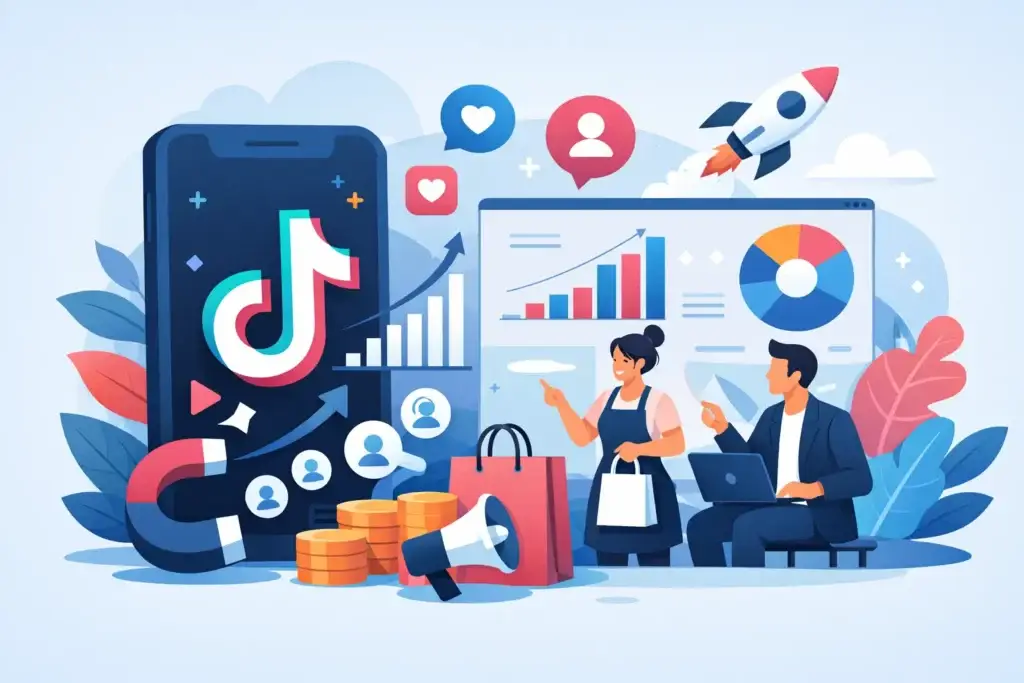
A lot of small businesses open TikTok, post a few videos, get a couple hundred views, and decide the channel is a waste of time. That usually is not a TikTok problem. It is a strategy problem. TikTok marketing for small business works when the content is tied to a clear offer, the videos are built for attention, and the account is managed like a growth channel instead of a hobby.
For SMEs, that distinction matters. You do not need vanity metrics. You need qualified attention, more inquiries, more store visits, more product sales, or lower customer acquisition costs. TikTok can help with all of that, but only if you stop treating it like a platform for random trends and start treating it like a distribution engine.
Why TikTok marketing for small business is worth considering
TikTok gives smaller brands something they rarely get on other channels – the chance to earn reach without a massive budget or a large existing audience. A useful video, a sharp hook, or a clear point of view can travel further than your follower count suggests. For a small business, that lowers the barrier to entry.
That said, reach alone is not the win. The real value is that TikTok sits high in the discovery phase. People use it to find products, compare options, learn quick tips, and get a feel for whether a business is credible. If you sell visually, solve a common problem, or can explain your value quickly, TikTok can shorten the path between awareness and action.
This is especially true for businesses in food, beauty, retail, fitness, home services, education, events, and B2C services. It can also work for B2B and higher-consideration services, but the content angle has to change. A SaaS company should not copy a cafe. An interior design firm should not post like a skincare brand. The channel is flexible, but the format needs to match how people buy from you.
What small businesses get wrong on TikTok
Most underperforming accounts make one of three mistakes. First, they copy trends that have nothing to do with their offer. That may create activity, but it rarely creates demand. Second, they post without a content system, so performance depends on guesswork. Third, they treat organic content and paid media as separate worlds when the best results often come from using them together.
There is also a timing issue. Many business owners expect direct sales from every post. TikTok does not always work that way. Some videos build trust. Some test angles. Some create retargeting audiences. Some are strong closers. If you judge every asset by last-click revenue alone, you will misread what the channel is doing.
A practical TikTok strategy for SMEs
A small business does not need a large production setup to make TikTok useful. It needs clarity. Start with the business goal. Are you trying to generate leads, sell lower-ticket products, book consultations, or drive foot traffic? Your goal should decide the content style, offer, and call to action.
Once that is clear, build content around three lanes. The first lane is proof. Show the product in use, before-and-after outcomes, customer reactions, or real examples of your work. The second lane is education. Answer the questions buyers ask before they convert. The third lane is decision support. Explain pricing logic, timelines, common mistakes, what to expect, or why one option fits better than another.
This mix tends to outperform random entertainment because it supports the buying process. It also gives you enough variation to test what earns attention versus what moves someone closer to action.
Hooks matter more than editing
On TikTok, weak openings kill good content. Your first second has to create enough tension or relevance to keep someone watching. For a service business, that might be a direct pain point like, “Why your landing page gets traffic but no leads.” For retail, it might be a quick visual payoff. For F&B, it could be a close-up of the product before you explain anything.
Polished editing helps, but it is not the main lever. Clear framing, strong hooks, and a useful payoff matter more. Many small businesses overestimate production and underestimate messaging.
Your offer has to be visible
One of the biggest gaps in TikTok marketing for small business is that the viewer understands the video but not the next step. If someone likes what they see, what are they supposed to do now? Visit your profile, send a message, claim a promotion, book a call, or visit the store?
The call to action should feel natural, not forced. But it needs to exist. If your account builds interest and your profile gives no reason to act, you are paying for attention you cannot convert.
Organic content and paid TikTok should work together
For most SMEs, organic TikTok is a testing environment. Paid TikTok is the scaling engine. Organic helps you learn what messages, formats, and hooks earn attention. Paid helps you push winning angles to the right audiences with more consistency.
This is where many businesses waste budget. They launch ad campaigns before they know what creative actually resonates. A smarter setup is to post consistently, identify videos with strong watch time or engagement quality, and then adapt those into ads with a clearer offer and tracking in place.
If you already run Google Ads or Meta Ads, TikTok should not sit in isolation. The buyer journey often crosses platforms. Someone may discover you on TikTok, search your brand on Google later, and convert after seeing a remarketing ad on another channel. That is why channel coordination matters more than platform-specific vanity metrics.
What content works best on TikTok for small business
The short answer is content that reduces uncertainty. People buy faster when they can picture the result, trust the seller, and understand the next step.
For product-based businesses, that usually means demonstrations, comparisons, use cases, unboxings, problem-solution clips, and customer proof. For service businesses, it often means explaining how the process works, showing real outcomes, addressing objections, and giving practical advice that proves expertise.
Founder-led content can work well too, especially for small businesses where trust is tied to the person behind the company. It does not need to be overly personal. It just needs to feel credible and specific. A business owner speaking plainly about what customers get wrong can outperform a highly edited brand video because it feels direct and earned.
What does not work as well? Generic motivational content, trend-chasing with no business relevance, and videos that spend too long setting up before making a point. If the viewer has to work to understand why the content matters, you have probably lost them.
How to measure if TikTok is actually working
Views are not enough. They can be useful as an early signal, but they do not tell you whether the channel is producing business value. Small businesses should track deeper indicators such as profile visits, qualified clicks, lead form submissions, direct messages, add-to-carts, purchases, booked calls, or store traffic where possible.
You should also look at creative-level signals. Which topics get better hold rates? Which hooks produce stronger click-through rates? Which videos attract the right comments from actual buyers rather than passive viewers? Those details tell you what to make more of.
There is a trade-off here. Not every business will get clean attribution from TikTok, especially if the sales cycle is longer or customers convert later through branded search. That does not mean the platform is underperforming. It means your measurement setup needs to account for assisted conversions and cross-channel behavior.
When TikTok is not the right first move
TikTok is not always the first channel a small business should prioritize. If your website is weak, your offer is unclear, or you have no way to capture demand, adding more attention can expose those gaps rather than solve them. The same goes for businesses with extremely narrow audiences or buyers who are unlikely to engage with short-form video.
In those cases, it may make more sense to fix the conversion path first or start with search-led channels where intent is already strong. Then TikTok becomes a growth multiplier rather than a distraction.
That is the practical view. TikTok is powerful, but it is not magic. It works best when the business already knows what it sells, who it helps, and what action it wants the audience to take.
If you are serious about using TikTok for growth, treat it like a real acquisition channel. Build content around buyer intent, test quickly, keep the offer visible, and measure what happens after the view. Small businesses do not need more noise. They need channels that can earn attention and turn it into revenue.