A lot of small business owners ask the same question right after launching a site or watching leads slow down: should we invest in SEO or pay for Google Ads? When people search for seo vs google ads for small business, what they usually mean is simpler – which one will bring in real inquiries without wasting budget.
The honest answer is not that one channel is better in every case. It depends on your sales cycle, margins, timeline, website quality, and how urgently you need pipeline. If you want leads this month, Google Ads usually gets you there faster. If you want to reduce dependency on paid traffic over time, SEO matters. Most growing businesses do not choose one forever. They choose the right sequence.
SEO vs Google Ads for small business: the real difference
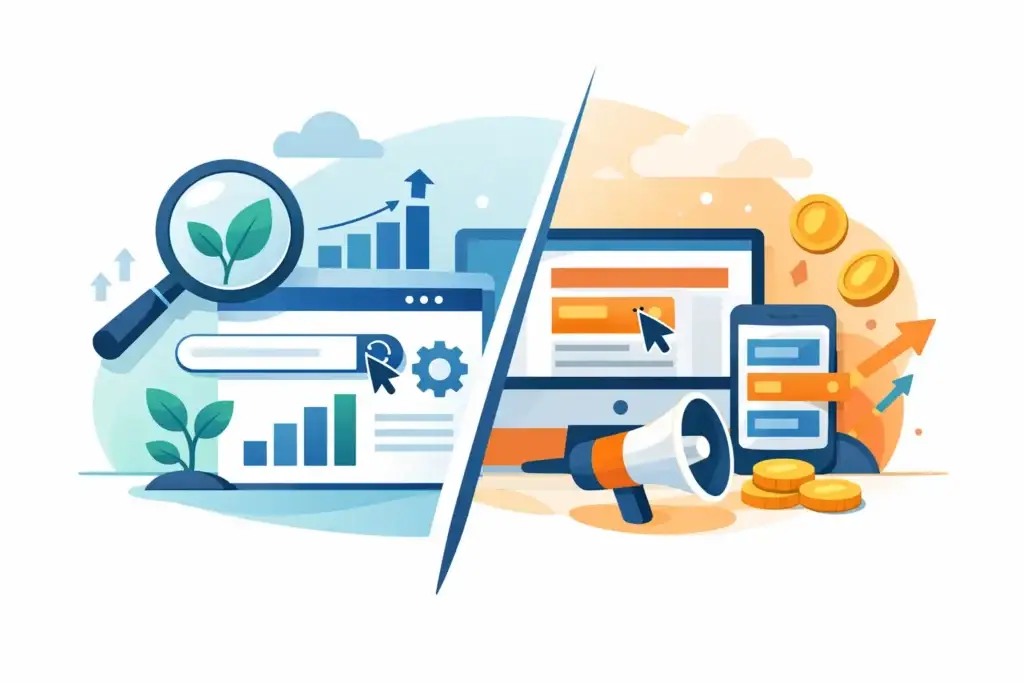
Google Ads buys visibility. SEO earns it.
With Google Ads, you can appear at the top of search results as soon as campaigns are live and approved. That makes it useful when you need demand capture now, whether you are a law firm, renovation company, dental clinic, B2B service provider, or ecommerce brand with proven conversion data. You control budgets, target keywords, geography, timing, and landing pages. You can turn campaigns up, down, or off based on performance.
SEO works differently. You are improving your website, content, technical setup, and authority so Google sees your pages as worth ranking organically. You do not pay for each click, but you do pay in time, execution, and consistency. Results usually take longer, especially in competitive markets. The payoff is that once rankings improve, traffic can scale without paying for every visitor.
For small businesses, the biggest mistake is treating this as a philosophical debate. It is an operational decision. You are choosing between speed and compounding returns, and often the best answer is how to use both without spreading budget too thin.
When Google Ads makes more sense
If your business needs leads quickly, Google Ads is usually the first move. This is especially true when you already know what service you want to sell, who you want to reach, and what a lead is worth.
A local service business is a good example. If someone searches for emergency plumbing, corporate catering, commercial cleaning, or payroll software, they already have intent. Ads let you show up for those searches immediately. That matters when every week without leads affects revenue.
Google Ads also gives you faster feedback. You can test offers, headlines, landing pages, locations, and keyword groups in weeks instead of waiting months. For small businesses without a big marketing team, this matters. You learn what converts before investing heavily in long-form content or broad SEO campaigns.
Another advantage is control. If one service line is more profitable, you can put budget there. If a location underperforms, you can exclude it. If calls are stronger during business hours, you can adjust bidding. That level of precision is hard to match with organic search.
The trade-off is simple: once you stop paying, traffic stops. Poor account setup also burns cash quickly. Broad match keywords, weak negative keyword lists, and sending traffic to generic pages can create a nice-looking click report and a disappointing sales report.
When SEO is the smarter investment
SEO makes more sense when search demand exists consistently and you want to build a durable acquisition channel. It is often the better long-term play for businesses with a clear niche, repeatable services, and the patience to build visibility properly.
If you operate in a category where prospects research before they buy, SEO can be powerful. Think accounting firms, architecture studios, managed IT providers, clinics, software companies, and specialty retailers. People compare options, read service pages, look for trust signals, and return more than once before converting. Strong organic visibility helps you show up throughout that process.
SEO also improves more than rankings when done properly. It forces you to tighten site structure, service messaging, page speed, and content clarity. That often lifts conversion rates across all traffic sources, including paid campaigns.
The trade-off is timing. SEO rarely solves an immediate pipeline problem. It is also not as simple as publishing a few blog posts. If your site is weak, your pages do not match search intent, or your local presence is inconsistent, results stall. Small businesses often underinvest in the execution side and then conclude SEO does not work.
Cost: cheaper is not always cheaper
Many business owners assume SEO is cheaper because you are not paying for each click. That is only partly true.
Google Ads has direct media cost. You pay for traffic, and in competitive industries those clicks can be expensive. But the returns can be visible faster, which makes the math easier to manage. If you spend $2,000 and can trace that to qualified leads and revenue, the channel can justify itself quickly.
SEO does not charge per click, but it still requires ongoing investment in technical work, content, on-page improvements, local optimization, and reporting. It can be more cost-efficient over time, but only if the work is strategic and sustained.
For a small business, the right question is not which channel costs less. It is which channel gets you profitable customer acquisition at your current stage.
If cash flow is tight and you need immediate sales, a lean Google Ads setup with tight keyword targeting may outperform a slow SEO ramp. If you already have some baseline lead flow and want to reduce paid dependency over the next 6 to 12 months, SEO deserves more weight.
Lead quality and buyer intent
Both channels can bring in high-intent traffic, but the pattern is different.
Google Ads tends to capture bottom-of-funnel demand well. Someone searches a service, sees your offer, clicks, and converts if the landing page is strong and the fit is right. It is direct and measurable.
SEO can capture both bottom-of-funnel and research-stage traffic. That is useful if your buyers need education before they commit. A business that sells high-ticket services may benefit from ranking not just for service keywords, but also for comparison and problem-aware searches that build trust earlier.
That said, organic traffic can look impressive while producing weak commercial intent if the keyword strategy is loose. Traffic alone is not the goal. Qualified inquiries are. This is why service pages, local pages, and conversion-focused content matter more than vanity metrics.
SEO vs Google Ads for small business: what to choose first
If you are choosing one channel first, use a simple filter.
Start with Google Ads if you need leads in the next 30 to 90 days, have a validated offer, and can close business reliably. Paid search gives you speed, clear attribution, and fast market feedback. It is the practical first move for many SMEs trying to generate momentum.
Start with SEO first if you already have some lead flow, your market has steady organic demand, and you are willing to invest consistently for long-term visibility. This is often the better path for businesses thinking beyond the next quarter.
Start with both only if you can fund both properly. Running weak campaigns and half-done SEO at the same time usually creates mediocre results in both channels.
A common approach that works well is sequencing. Use Google Ads to generate leads now while building SEO assets in parallel. The paid campaigns show which keywords convert. Those insights can then shape service pages, location pages, and content strategy. Over time, SEO starts carrying more of the demand capture, which reduces pressure on paid media.
That is usually the most commercially sensible setup. It respects cash flow, gives you immediate data, and builds a stronger acquisition engine instead of forcing an either-or decision.
The website decides more than the channel
Many small businesses blame SEO or Google Ads when the real issue is the site. If your pages are slow, unclear, generic, or weak on trust, both channels underperform.
A search campaign can send qualified visitors to your site, but it cannot fix weak positioning. SEO can improve rankings, but ranking a poor page does not create demand. Before scaling either channel, make sure the website does the basics well: clear offer, clear geography, proof, fast load speed, obvious calls to action, and pages built around actual search intent.
This is where a lot of growth gets left on the table. Businesses spend on traffic before fixing conversion paths.
What small businesses should avoid
Do not choose SEO because it sounds free. Do not choose Google Ads because it sounds fast. Those are half-truths.
Avoid agencies or freelancers who treat performance channels as separate silos. Paid search and SEO inform each other. Search term data, landing page behavior, call tracking, and conversion patterns should shape both. A coordinated setup almost always performs better than fragmented execution.
Also avoid broad promises. No one can guarantee rankings for competitive terms on a timeline they do not control. No one should promise profitable Google Ads without discussing budget, conversion rates, and sales quality. Serious operators talk about systems, tracking, and iteration.
For most SMEs, the better decision is not SEO or Google Ads. It is whether your business is ready to turn search demand into revenue. If the answer is yes, then the channel mix becomes a growth decision, not a gamble.
If you need results now, start where intent is strongest and measurement is clearest. Then build the organic foundation that makes every future click less expensive. That is usually the point where marketing stops feeling like cost and starts behaving like infrastructure.