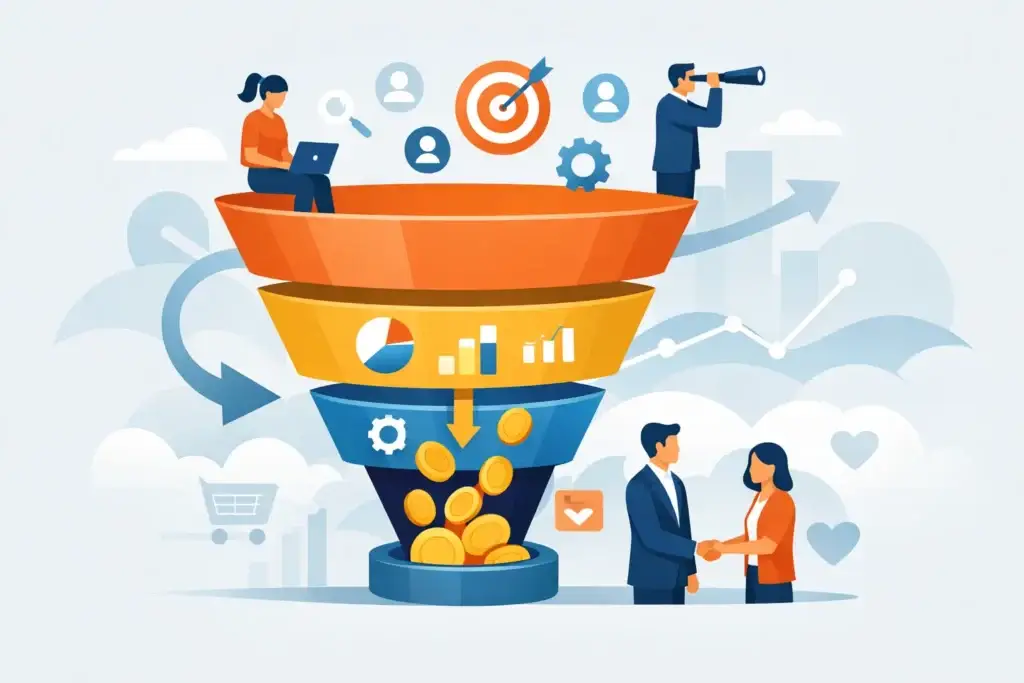
Most SMEs do not have a traffic problem. They have a conversion path problem. They run Google Ads, post on social media, maybe publish a few SEO articles, but the pieces do not connect. A full funnel marketing strategy fixes that by making every channel do a specific job from first click to closed sale.
That matters because growth rarely comes from one campaign or one platform. Paid search can capture demand fast, SEO can build long-term visibility, Meta can create interest, and your website can either convert that attention or waste it. If those parts are managed separately, performance usually stalls. If they are coordinated, you get clearer data, lower waste, and better lead quality.
What a full funnel marketing strategy actually means
A full funnel marketing strategy is a plan for attracting people who do not know you yet, moving interested prospects toward action, and converting ready buyers without losing them in the gaps. In practical terms, it means matching the right message, channel, and landing experience to each stage of buyer intent.
At the top of the funnel, your job is visibility and awareness. This is where SEO content, social media, TikTok, Meta, and broad audience campaigns often play a role. The goal is not immediate efficiency at any cost. The goal is to get in front of the right people early enough that your business becomes a known option.
In the middle of the funnel, the focus shifts to consideration. People are comparing providers, checking reviews, reading service pages, and deciding whether your business feels credible. This is where remarketing, case-study-style content, reputation management, and clearer product or service pages matter.
At the bottom of the funnel, buyers are closer to action. They search with high intent, click on specific offers, ask for pricing, and evaluate response speed. Google Search Ads, focused landing pages, strong calls to action, and fast lead handling usually carry more weight here.
The mistake many businesses make is overinvesting in one stage. If you only run bottom-funnel campaigns, you may get leads quickly, but costs often rise because you are competing for the same ready-to-buy audience as everyone else. If you only build awareness, you may generate attention without revenue. A workable strategy balances short-term conversion with long-term demand creation.
Why SMEs struggle to build a full funnel marketing strategy
Most smaller businesses are not failing because they chose the wrong platform. They struggle because execution is fragmented. One vendor handles paid ads, another built the site, someone internal posts on social, and nobody owns the handoff between traffic and conversion.
That creates familiar problems. Ad campaigns send users to generic pages. SEO content brings in visitors who never see a relevant offer. Social campaigns generate interest, but there is no remarketing sequence. Leads come in, but follow-up is slow or inconsistent. Reporting then becomes a stack of disconnected channel metrics instead of a business view of what is producing pipeline.
This is where a coordinated setup matters more than channel count. You do not need to be everywhere. You need each active channel to support the next step.
The three working parts of the funnel
Traffic acquisition
This is how people find you. For many SMEs, the strongest mix includes Google Search Ads for immediate demand capture, SEO for compounding visibility, and paid social for audience building and retargeting. If your market includes Chinese-speaking consumers, platforms like XHS can also play a meaningful role, especially for discovery and trust.
The right mix depends on your sales cycle and intent level. A home services company may get fast returns from search because people already know what they need. A newer brand or a visually driven product may need more top-funnel social activity to create demand before search volume follows.
Conversion environment
This is where most money gets wasted. You can buy traffic all day, but if users land on a slow, unclear, or generic page, the funnel breaks. Your website, landing pages, contact forms, offer structure, and proof elements are not support assets. They are part of the marketing engine.
A good conversion environment answers obvious questions fast. What do you do, who is it for, why should someone trust you, and what should they do next? If those points are buried, even strong campaigns underperform.
Follow-up and measurement
A lead is not revenue. That sounds obvious, but many businesses still judge campaigns only by front-end metrics. Click-through rates and impressions are useful, but they do not tell you whether the leads were qualified, whether sales followed up fast enough, or which channel is producing actual customers.
A serious full funnel marketing strategy includes lead tracking, source attribution, and a feedback loop between marketing and sales. If low-quality leads are coming from one campaign, the answer may not be to cut spend immediately. You may need tighter targeting, a better offer, or a more qualifying landing page.
How to build a full funnel marketing strategy that works
Start with your sales reality, not a channel wish list. Look at how customers actually buy from you. Do they search with urgency, compare options for weeks, or need repeated exposure before they inquire? A B2B service with a longer decision cycle needs a different funnel from a restaurant or retail campaign.
Next, define one primary conversion goal. For some businesses, that is a form lead. For others, it is a phone call, booked consultation, or direct purchase. If you try to optimize for everything at once, performance gets noisy fast.
Then align channels by role. Search ads are often best for bottom-funnel demand capture. SEO and content help build authority and bring in non-paid traffic over time. Meta and TikTok can create awareness, support remarketing, and keep your brand visible during the consideration phase. The point is not to force every channel to close the sale. The point is to give each channel a job.
After that, tighten the landing experience. A common issue with SME campaigns is sending all traffic to the homepage. That usually underperforms because homepages serve too many audiences at once. Campaign-specific pages almost always give you cleaner messaging and better conversion data.
You also need offers that match intent. Someone searching “emergency plumber” should not land on a general brand story. Someone discovering your business through social may need stronger education and proof before they are ready to contact you. Intent mismatch is one of the biggest reasons funnels leak.
Finally, build reporting around decisions. Do not just track channel metrics. Track cost per qualified lead, sales conversion rate by source, and time to inquiry response. Those numbers tell you where the funnel is actually breaking.
Full funnel marketing strategy examples by business type
For a local service business, the funnel often starts with Google Search Ads and local SEO because demand already exists. Meta remarketing then helps recover visitors who did not inquire on the first visit. The website needs fast mobile performance, strong trust signals, and simple inquiry forms. In this case, top-funnel activity matters, but bottom-funnel efficiency usually drives the first wave of results.
For a B2B company, the funnel tends to be longer. SEO content can answer early research questions. Search ads can target high-intent keywords. Linked social or Meta remarketing can keep the brand in front of decision-makers after the first visit. Landing pages should qualify leads clearly so the sales team is not spending time on poor-fit inquiries.
For an eCommerce brand, the mix is usually broader. Paid social and short-form video can drive discovery, branded and non-branded search can capture intent, and email or remarketing helps bring back visitors who abandoned the path to purchase. Here, your product page and checkout flow are as important as the ad creative.
What to expect from results
A full funnel setup does not mean every channel pays back at the same speed. Search ads can produce leads faster because they capture existing demand. SEO takes longer but can reduce dependency on paid traffic over time. Social awareness campaigns may look weaker in last-click reporting even when they improve branded search and conversion rates later.
That is why channel evaluation needs context. If you cut every activity that does not generate immediate last-click ROI, you may shrink future demand and make your bottom-funnel campaigns more expensive. On the other hand, if you keep spending on awareness without proof it is feeding qualified traffic, you are just paying for attention.
The right answer is disciplined testing. Give each channel a role, a timeframe, and a success metric tied to business outcomes.
Where businesses usually get better results
The biggest gains often come from fixing coordination, not adding more tools. Better handoff from ads to landing pages. Better messaging from awareness content to service pages. Better remarketing between first visit and inquiry. Better visibility into which channels bring qualified leads instead of just cheap clicks.
That is why a full funnel approach is less about complexity and more about control. When one team owns the traffic, the website experience, and the reporting logic, you can move faster and waste less. That is also why businesses working with execution-focused partners like AdCendes often improve performance without needing a huge media budget increase.
If your marketing feels busy but not cumulative, that is usually the signal. The next step is not another campaign. It is building a funnel where each piece earns its place and pushes the next action forward.