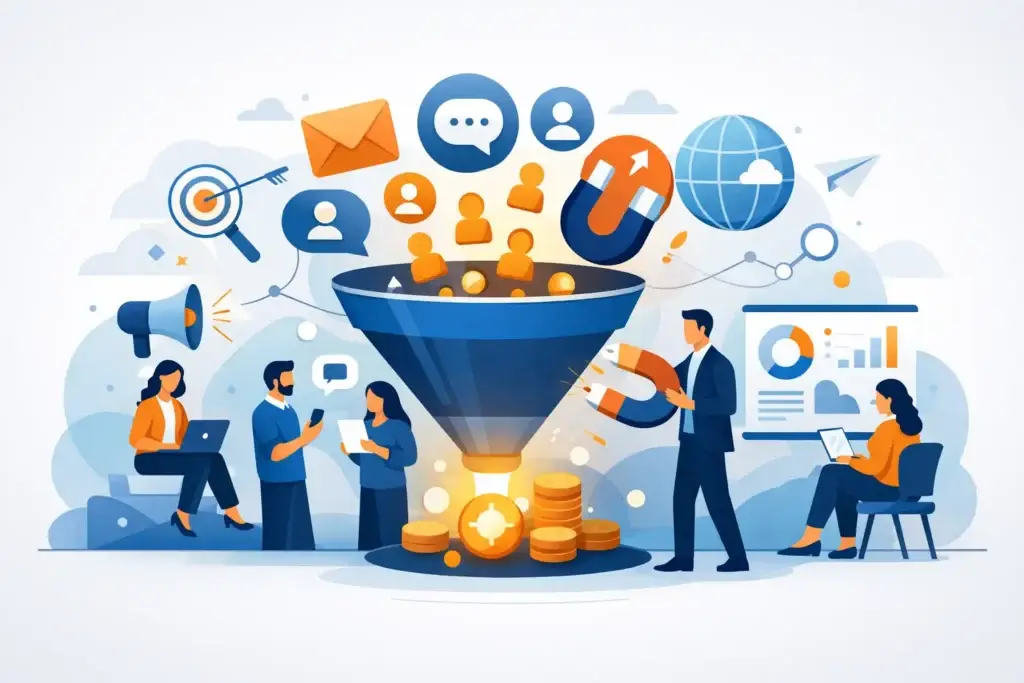
Most SMEs do not have a lead problem. They have a channel selection problem. Money gets spread across SEO, ads, social, and website work without a clear view of which source can bring demand now, which one compounds later, and which one simply looks busy on a report.
The best lead generation channels are not the ones with the most hype. They are the ones that match your sales cycle, margins, market awareness, and internal capacity to follow up. A B2B service firm with high-value deals should not copy an ecommerce brand’s channel mix. A local business that needs inquiries this month should not wait six months for traction if paid search can start generating demand next week.
What makes a lead generation channel worth the budget
A good channel does three things. It puts your offer in front of the right audience, it gives you enough control to improve performance, and it can be measured against real business outcomes rather than vanity metrics.
That sounds obvious, but many businesses still choose channels based on familiarity. The founder likes Instagram, so the company invests in Instagram. A competitor posts on TikTok, so now TikTok becomes the priority. This is backward. Channel decisions should start from buying intent, conversion path, and deal economics.
If your average customer is worth $10,000, you can afford channels with higher customer acquisition costs and longer nurturing. If your margins are thin, the channel has to be efficient fast. If your sales process requires consultation, your website and follow-up matter as much as traffic quality.
The best lead generation channels by business intent
1. Google Search Ads for high-intent demand
For many SMEs, Google Search Ads remains one of the best lead generation channels because it captures people already looking for a solution. That makes it especially effective for service businesses, B2B companies, local providers, and any offer tied to an urgent need.
The main advantage is speed. You can launch quickly, test keyword groups, and see which search terms produce actual inquiries. The trade-off is cost. Competitive industries can get expensive, and weak landing pages can waste good traffic.
Search Ads work best when the buyer knows what they need. If someone searches for commercial interior design firm, HR software demo, or payroll outsourcing services, the intent is clear. Your job is to match that intent with a relevant page, a credible offer, and a fast response process.
2. SEO for compounding inbound leads
SEO is slower than paid search, but it creates durable visibility. For SMEs that want lower dependency on ad spend over time, it is one of the best lead generation channels available.
What makes SEO commercially useful is not traffic volume alone. It is ranking for pages that attract the right prospects. Service pages, comparison pages, location pages, and problem-aware content usually matter more than broad blog traffic.
The trade-off is patience and execution discipline. SEO works when technical basics, site structure, conversion pages, and content strategy are aligned. If your website is weak or your offer is unclear, more organic traffic will not fix that. It will just expose the problem faster.
3. Website landing pages as a conversion channel
This is where many businesses miss the point. A website is not just a brochure that supports other channels. In practice, it is part of the channel itself because conversion quality depends on what happens after the click.
A strong landing page can double the output of your paid and organic traffic without increasing spend. A weak one can make every channel look worse than it really is. Clear positioning, specific proof, visible calls to action, and a simple inquiry path matter more than visual flair.
For lead generation, the page should answer three questions fast: what do you do, who is it for, and why should someone trust you. If the visitor has to work too hard to figure that out, they leave.
4. Meta Ads for demand creation and retargeting
Meta Ads are not always the first channel to use for direct lead capture, but they are powerful when the offer has broad appeal or when retargeting is part of the system. For some B2C services, education-led offers, events, and visually driven businesses, Meta can produce efficient leads at scale.
The key difference from search is intent. People on Meta are not actively looking for you in the same way. You are interrupting attention rather than harvesting demand. That means your creative, offer, and audience setup carry more weight.
Meta often performs best when paired with another channel. Search captures demand. Meta retargets visitors who did not convert. That coordination usually beats running either channel in isolation.
5. Content marketing for trust and deal acceleration
Content marketing is often treated as a soft brand play. For SMEs, that is the wrong lens. Good content reduces sales friction. It helps buyers understand your process, compare options, and get comfortable contacting you.
This matters most in considered purchases where leads do not convert on the first visit. Case-study style articles, service explainers, pricing guidance, and objection-handling content can shorten the path from interest to inquiry.
The trade-off is that content rarely works as a standalone tactic. It needs distribution through SEO, email, social, or remarketing. Without that, you are publishing assets with no route to demand.
6. LinkedIn for niche B2B outreach
For B2B firms selling to specific roles, LinkedIn can be one of the best lead generation channels, but only when expectations are realistic. It is not a magic volume machine. It is a precision tool.
If you know your ideal buyer by title, industry, and company size, LinkedIn helps you reach them directly through paid campaigns, founder-led content, or targeted outbound activity. It is especially useful for higher-ticket services where fewer, better leads are more valuable than raw volume.
The trade-off is that LinkedIn usually requires sharper messaging and stronger proof than broad-reach platforms. Generic claims get ignored quickly.
7. Email marketing for lead nurturing and reactivation
Email is rarely the first acquisition source, but it is one of the highest-leverage channels once leads enter your system. If a prospect is not ready today, email gives you a low-cost way to stay relevant without paying again for the same attention.
This is valuable for long sales cycles, repeat services, and businesses with a growing database of past inquiries or customers. Follow-up sequences, useful updates, and segmented offers can recover leads that would otherwise disappear.
The mistake is sending generic newsletters with no commercial purpose. Email should support pipeline movement, not just maintain activity.
8. Platform-specific social channels for niche audiences
Not every audience lives on the same platform. If your buyers are highly active on TikTok, YouTube, or Xiaohongshu, those channels can become serious lead sources. The point is not to be everywhere. The point is to show up where trust is actually built for your market.
For example, brands targeting Chinese-speaking consumers may see stronger traction on Xiaohongshu than on mainstream Western platforms. Businesses with visually demonstrable results may perform better on short-form video than on text-heavy channels. The right platform depends on audience behavior, not marketer preference.
How to choose the best lead generation channels for your business
Start with intent. If buyers are searching for your solution already, put paid search and SEO near the top of the list. If your market needs education before action, content and social may need to support the journey first.
Then look at time horizon. If you need leads this month, use channels that can activate fast. If you want lower acquisition costs over the next year, build SEO and content in parallel. Most SMEs do better with a mixed model than a single-channel bet.
You also need to factor in operational readiness. There is no value in generating more leads if response time is poor, tracking is unreliable, or the website does not convert. Channel performance is often limited by execution after the click, not before it.
A practical starting point for many SMEs is simple: use Google Search Ads for immediate demand capture, build landing pages that convert, invest in SEO for long-term growth, and add retargeting or email to improve conversion efficiency. That is usually a stronger foundation than spreading budget across five under-managed platforms.
At AdCendes, this is the logic behind channel coordination. Fast channels create momentum. Long-term channels reduce dependency. The website turns traffic into inquiries. Reporting shows what is actually moving revenue.
The real question is not which channel is best
The real question is which channel deserves to be first, which one should support it, and what needs to be fixed before scaling budget. That is a better way to think about lead generation because it keeps the focus on business outcomes rather than channel trends.
If your current mix is producing traffic but not enough qualified leads, do not assume you need another platform. You may need a clearer offer, a better landing page, or tighter coordination between channels. The businesses that grow steadily are usually not doing more marketing. They are doing the right marketing in the right order.