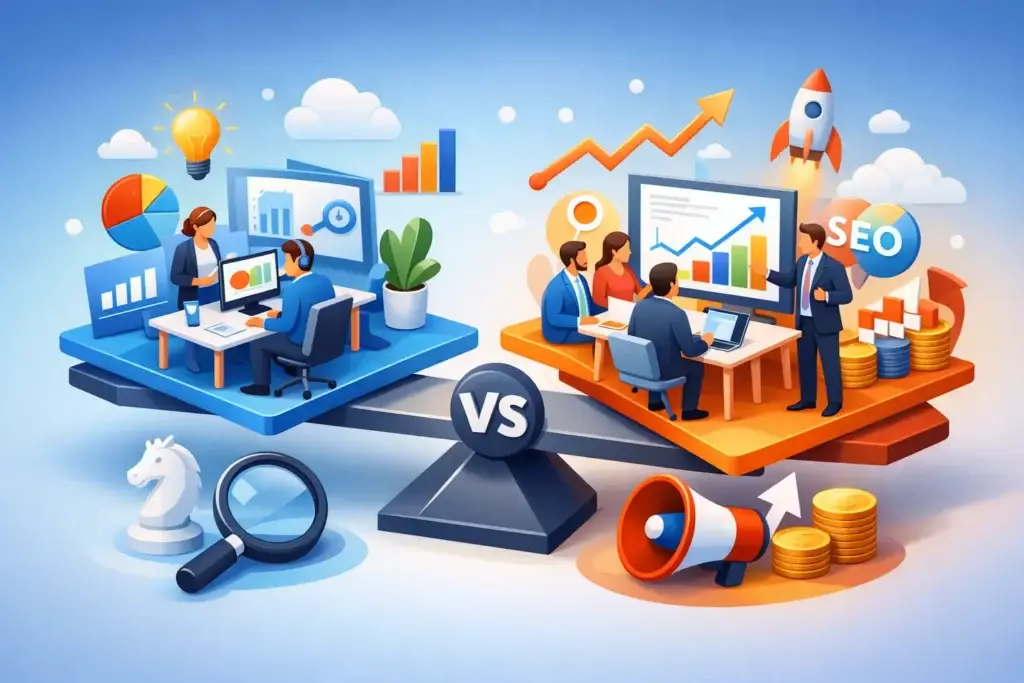
A lot of SMEs make the same expensive mistake. They hire one marketer, expect that person to handle paid ads, SEO, content, social media, reporting, website fixes, and lead generation, then wonder why results stall after a few months. That is usually where the real in house marketing vs agency question starts – not as a theory exercise, but as a growth bottleneck.
If you are deciding where to put budget next, the right answer is rarely about pride or preference. It comes down to what your business needs right now, how fast you need results, and whether you need breadth, depth, or tighter day-to-day control.
In house marketing vs agency: the real difference
On paper, the choice looks simple. An in-house team gives you proximity, brand familiarity, and direct oversight. An agency gives you specialist skills, faster setup, and a wider channel mix.
In practice, the gap is operational. In-house marketing means you are building capability inside the business. You hire people, train them, manage priorities, buy tools, and accept that performance depends heavily on who you can recruit and retain. Agency support means you are buying execution capacity and experience that already exists. You are not starting from zero.
That distinction matters more than most businesses realize. If your goal is to build a long-term internal marketing function, in-house can make sense. If your goal is to generate leads in the next 30 to 90 days without building a department first, agency support usually gets there faster.
Cost is not just salary
Founders often assume in-house is cheaper because they compare one salary to one retainer. That is not the full math.
A single in-house marketer may cost less on paper than a multi-channel agency engagement, but one person rarely covers strategy, media buying, creative, SEO, analytics, CRM coordination, landing page optimization, and reporting at a high level. To match that range internally, you usually need multiple hires or a very senior generalist with outside support.
Then there are the hidden costs. Recruiting takes time. Bad hires are expensive. Tools add up. Management overhead is real. If the person leaves, knowledge leaves with them unless you have strong processes.
An agency can look more expensive month to month, but it often gives access to a team instead of an individual. That matters if you need Google Ads management, SEO content planning, Meta campaign optimization, conversion tracking, and website updates moving together.
The better question is not which option is cheaper. It is which option produces results at a lower cost per qualified lead, lower cost per sale, or stronger revenue contribution.
Speed favors agencies in most cases
If your business needs demand generation now, agency support usually has the edge.
An experienced agency already has account structures, reporting workflows, optimization routines, and channel specialists in place. That means campaigns can launch quickly, data can be interpreted correctly, and weak spots can be fixed without waiting for a new hire to figure things out.
In-house teams can absolutely move fast, but only after the right people and systems are already there. For many SMEs, that setup phase is exactly the problem. You are trying to grow while still hiring the people who are supposed to help you grow.
This is one reason many businesses use external support to create momentum first. Paid search can generate short-term demand. SEO and content can build long-term visibility. Landing pages can improve conversion. Once those systems are running, it becomes easier to decide what should stay external and what should move in-house over time.
Control favors in-house, but not always in the way people expect
The strongest argument for in-house marketing is control. Your team sits closer to the product, the sales process, customer questions, and internal priorities. Communication is faster. Feedback loops are tighter. Messaging can be refined in real time.
That advantage is real, but it gets overstated.
A poorly managed in-house team does not create real control. It creates the feeling of control. If reporting is inconsistent, campaign decisions are based on guesswork, and channel execution depends on one overloaded employee, the business may be less informed than it thinks.
A good agency relationship can still give you strong control if the structure is right. That means client-owned ad accounts, transparent reporting, clear approval flows, and documented strategy. You should know what is being done, why it is being done, and what business outcome it is meant to drive.
The issue is not simply internal versus external. It is whether the work is visible, accountable, and tied to outcomes.
Skill depth is where agencies usually pull ahead
Marketing looks broad from the outside and fragmented from the inside. Paid search, technical SEO, copywriting, conversion rate optimization, analytics, email automation, short-form creative, and platform-specific media buying are different disciplines.
That is why many SMEs struggle when they hire one or two in-house marketers and expect full-funnel performance. Generalists can be excellent, especially at coordination and execution, but there is a limit. The deeper your channel mix gets, the more specialist knowledge matters.
An agency model is often stronger when you need multiple channels working together. If your business depends on immediate leads and long-term search visibility, for example, the combination of SEM, SEO, content, and landing page optimization is more effective when those pieces are coordinated rather than siloed.
For companies targeting niche audience segments, this matters even more. A business trying to reach both mainstream and Chinese-speaking markets may need Google, Meta, content, and platform-specific execution on channels like XHS. Building that range in-house is possible, but rarely efficient at SME stage.
Brand alignment is where in-house can outperform
There are cases where in-house is the better call.
If your product is complex, your sales cycle is highly consultative, or your messaging changes constantly based on internal developments, an in-house team may outperform an agency because they are immersed in the business every day. They can sit in on sales calls, hear objections firsthand, and adapt messaging faster.
This is especially true for businesses where marketing is tightly linked to product education, lifecycle campaigns, or cross-functional coordination with operations and customer success.
If you already have strong leadership, clear goals, enough budget for multiple hires, and the patience to build capability over time, in-house can become a strategic asset rather than just an execution arm.
The hybrid model is often the smartest answer
For many SMEs, the real answer to in house marketing vs agency is neither extreme.
A hybrid setup often works best. Keep core brand knowledge, approvals, and internal coordination in-house. Use an agency for specialist execution, campaign management, technical work, and channel scaling. That gives you speed without giving up visibility.
A practical version of this looks like one internal marketing lead or operations owner working with an external growth team. The internal side handles business priorities, sales feedback, product updates, and quick approvals. The external side manages paid media, SEO execution, content production, tracking, landing page improvements, and performance reporting.
This model is usually stronger than forcing a small internal team to do everything. It also reduces key-person risk. If one employee leaves, your growth engine does not collapse.
How to decide what fits your business
Start with the job you actually need marketing to do.
If you need leads quickly, have limited hiring capacity, and want multiple channels coordinated without building a department, agency support is usually the better commercial decision. If you need deep internal alignment, daily collaboration with product or sales, and long-term capability inside the business, in-house becomes more attractive.
Also look honestly at management bandwidth. In-house teams do not run themselves. Someone has to set targets, review performance, manage priorities, and maintain standards. If leadership is already stretched, hiring internally can create more complexity than momentum.
Then look at channel complexity. If you only need one focused function, such as content production or social media coordination, an in-house hire may be enough. If you need search ads, SEO, website conversion work, analytics, and platform expansion all moving together, agency support tends to be more efficient.
Finally, look at your stage. Early and growth-stage businesses usually benefit from execution speed and specialist access. More mature businesses with stable budgets and defined marketing processes can justify building more capability internally.
What a good decision looks like
The right model should make your business simpler, not heavier.
If in-house marketing gives you sharper market feedback, stronger brand consistency, and enough execution depth to hit targets, that is a solid choice. If an agency gives you faster results, clearer reporting, and better performance across channels without the overhead of building a team, that is just as valid.
What matters is not whether the work happens inside your office or outside it. What matters is whether marketing is producing measurable business movement. More qualified leads. Better conversion rates. Lower wasted spend. Clear ownership. Reliable reporting.
That is the standard worth using.
For most SMEs, the smartest move is not to chase the ideal org chart. It is to choose the setup that helps you execute well now, while leaving room to scale later. Marketing becomes far more useful when it is treated as an operating system for growth, not a headcount decision.