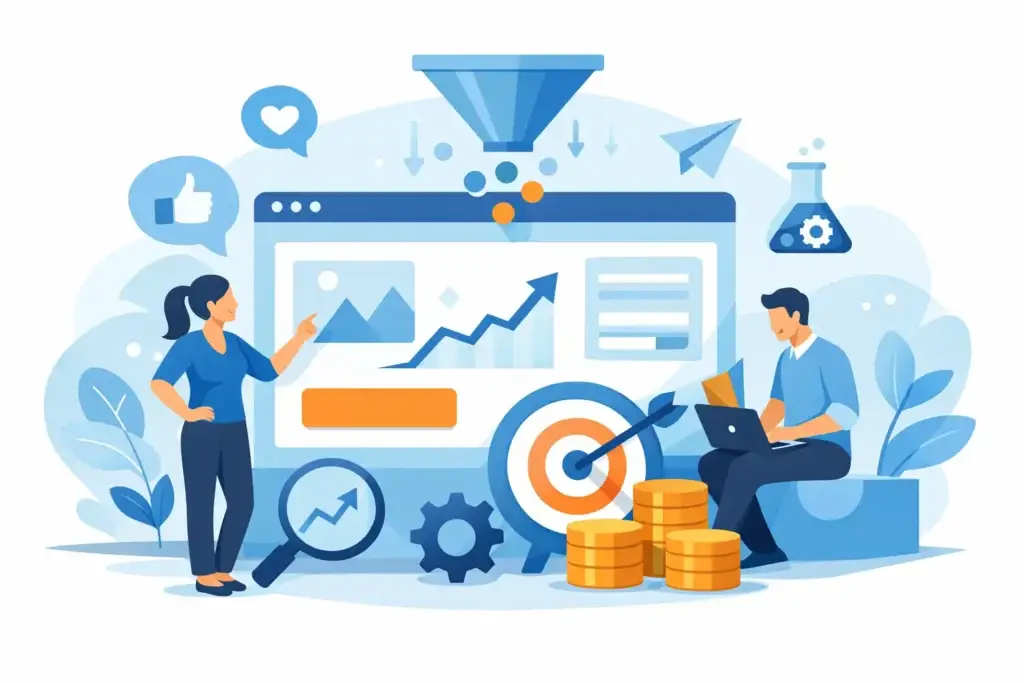
A landing page does not fail because the button color was wrong. Most of the time, it fails because the page asks a visitor to make a decision before the business has earned that decision.
That is the real starting point for how to improve landing page conversions. If you are paying for clicks through Google Ads, Meta Ads, SEO, or social traffic, every weak page quietly raises your cost per lead. More traffic will not solve that. A clearer offer, less friction, and tighter message-to-audience alignment usually will.
How to improve landing page conversions starts with traffic intent
Before changing headlines or redesigning sections, look at where visitors came from and what they expected to see. A landing page for high-intent Google Search traffic should feel different from one built for colder social traffic. Search users often want proof, pricing signals, and a direct path to action. Social users may need more context before they are ready to submit a form.
This is where many SMEs lose efficiency. They send every campaign to one generic page and hope the page can do everything. It usually cannot. If your ad says “same-day quote,” your page should reinforce speed immediately. If your keyword targets “commercial renovation contractor,” the page should not open with vague statements about quality and passion. It should confirm relevance in the first screen.
Conversion rates improve when the page matches the promise that generated the click. That sounds obvious, but in practice it requires discipline. Build around intent first, then design around it.
Fix the first screen before touching anything else
The top section of the page does most of the heavy lifting. In a few seconds, a visitor decides whether to continue or leave. If the first screen is weak, the rest of the page does not get a fair chance.
A strong first screen usually answers three things fast: what you offer, who it is for, and why someone should trust you now. If any of those are missing, people hesitate. And hesitation lowers conversions.
The most common issue is copy that sounds polished but says very little. Lines like “We help businesses grow” are too broad to do conversion work. A better headline is concrete and specific: what service, what outcome, what audience. Subheadings should support the main promise, not repeat it in softer language.
Visuals matter too, but only if they reduce uncertainty. Product screenshots, service workflows, before-and-after examples, or a real team photo often outperform decorative stock images. The goal is not to impress. The goal is to make the offer easier to understand.
One page, one primary action
A landing page should push one main conversion goal. If you ask visitors to call, email, download a brochure, watch a video, chat on WhatsApp, and book a demo all at once, you increase choice and reduce action.
That does not mean every secondary path must disappear. It means one action should clearly lead. If your best lead source comes from quote requests, make that the center of the page. Everything else should support it, not compete with it.
Your offer may be the real problem
Many businesses assume they have a page problem when they really have an offer problem. If the offer is weak, vague, or low-urgency, conversion improvements from design changes will be limited.
Ask a simple question: why should someone convert today instead of later? If the answer is unclear, the page will struggle. A stronger offer can be a faster turnaround, a free audit, transparent pricing, a limited onboarding slot, a trial, or a clear business outcome tied to the service.
That does not mean inventing fake urgency. People can spot that quickly. It means reducing uncertainty and giving the visitor a reason to take the next step now.
For SMEs, practical offers often work better than broad promotional language. “Get a 15-minute account review” is clearer than “Let’s grow together.” “Request a quote within one business day” is stronger than “Contact us for more information.” The more operationally specific the offer, the easier it is to evaluate.
Reduce friction in the form
If your form is long, intrusive, or badly timed, it will suppress conversions even if the rest of the page is solid. Every field adds a small cost. Sometimes that cost is worth it because better qualification improves lead quality. Sometimes it simply kills volume.
There is no perfect number of fields for every business. If you sell high-ticket B2B services, asking for company name and budget range may help. If you are trying to generate fast inquiries from local service buyers, a shorter form often performs better.
The trade-off is lead quality versus lead volume. That is why form decisions should be based on your sales process, not generic advice.
What to ask for and what to remove
Start with the minimum information needed for a real follow-up. Usually that means name, contact detail, and one qualifying field that helps route the lead. Remove anything you do not actively use in sales.
A form also needs support around it. Tell people what happens next. Will they get a callback in an hour, a quote in one business day, or a scheduled consultation? Clear next-step messaging reduces anxiety and makes the conversion feel lower risk.
Trust signals should answer doubt, not decorate the page
Trust matters most when the visitor is close to acting. Generic badges and empty testimonials do not help much. Relevant proof does.
If you want more inquiries, show evidence tied to the buying decision. That could include client logos, short case outcomes, review snippets, years of experience, certifications, media mentions, or a simple process that explains how work is delivered. The right proof depends on what your audience worries about.
A founder choosing a marketing partner may care about reporting clarity, account ownership, and speed to launch. A homeowner hiring a renovation firm may care about workmanship, timeline control, and project photos. A software buyer may care about security, onboarding, and integrations. Good trust signals are not generic credibility wallpaper. They remove specific objections.
Page speed and mobile experience still move the numbers
This part is less glamorous, but it matters. Slow pages create drop-off before users even assess the offer. Heavy images, bloated scripts, awkward mobile layouts, and sticky pop-ups can quietly waste paid traffic.
Most SME traffic is heavily mobile, especially from social and local search. If your page looks clean on desktop but feels cramped on a phone, your conversion data will suffer. Test the real mobile experience yourself. How quickly does the page load on cellular? Is the call to action visible without endless scrolling? Are form fields easy to tap? Does the page feel trustworthy on a small screen?
You do not need a fancy interactive design to convert well. You need speed, readability, and low friction.
How to improve landing page conversions with better page structure
A landing page should guide the visitor through a decision in the right order. Many pages dump every selling point at once. That creates noise, not persuasion.
A better structure usually moves from relevance to value, then proof, then action. First confirm the visitor is in the right place. Then explain the offer and outcome. Then handle objections with proof, FAQs, or process clarity. Then ask for the conversion again.
This matters because visitors do not all arrive equally ready. Some will convert from the first screen. Others need one or two more checkpoints. Your structure should serve both without feeling bloated.
If the page is long, repeated calls to action are useful. But each one should appear after meaningful information, not randomly between filler sections.
Test what matters, not random cosmetic changes
A lot of landing page testing produces activity without insight. Changing button colors, icon styles, or section spacing can matter at the margins, but these are rarely the biggest wins.
Test the high-impact variables first: headline, offer, form length, first-screen layout, proof placement, and call-to-action language. These affect visitor motivation and clarity. Cosmetic tests should come later.
Also, be careful with conclusions from low traffic. If your page gets limited visits, dramatic redesigns based on small sample sizes can create more confusion than progress. In those cases, use stronger qualitative checks too. Review session recordings, look at form abandonment, compare traffic sources, and talk to sales about lead quality.
The best conversion work is not design-led or traffic-led on its own. It is commercial. It connects acquisition, page experience, and sales follow-up into one system.
A conversion problem is sometimes a sales follow-up problem
This is the part many agencies ignore. If leads arrive but do not turn into revenue, the page may be blamed unfairly. Slow response times, weak qualification calls, unclear quoting, or no follow-up discipline can make a decent landing page look broken.
That is why businesses that want better results need to look past the form submission rate alone. Track lead quality, sales acceptance, close rate, and time to response. Sometimes the smartest landing page improvement is setting better expectations before the form and tightening what happens after it.
For growth-minded SMEs, that is the practical view. A landing page is not just a web asset. It is the handoff point between traffic spend and sales outcome. When messaging is clear, the offer is strong, friction is low, and follow-up is fast, conversion gains tend to show up quickly.
If you are serious about how to improve landing page conversions, start with the page you already have, but judge it like an operator, not a designer. Ask whether it matches intent, removes doubt, and makes the next step easy. That is where better lead flow usually begins.