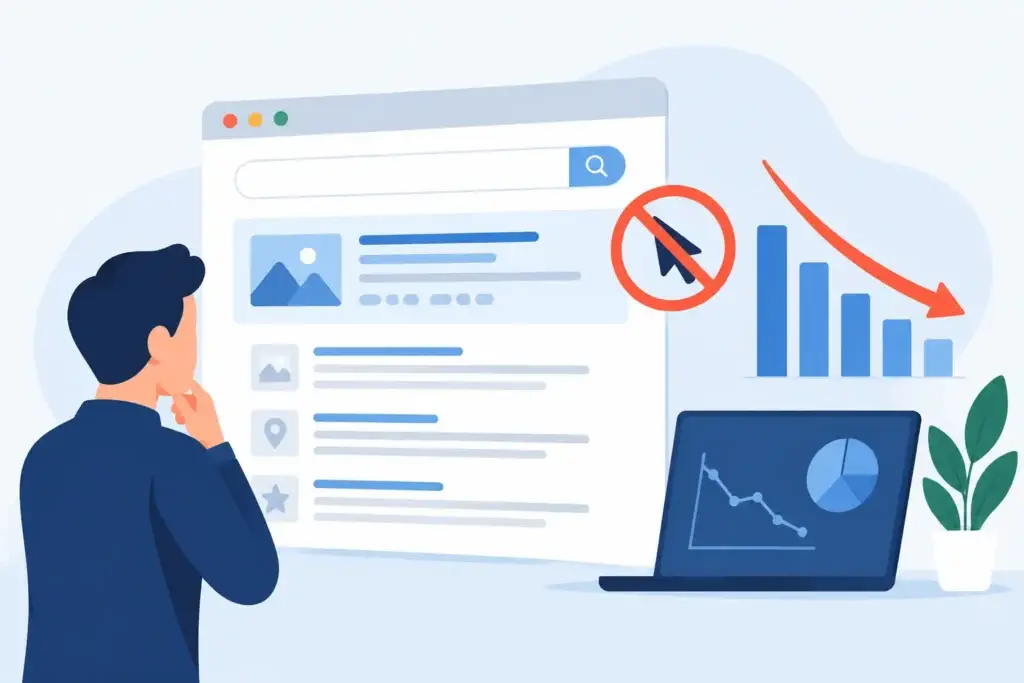
A prospect searches for your service, sees a Google answer box, reads a review snippet, checks the map pack, and never visits a website. That is zero click search in practical terms. The search still influenced their decision. It may even have generated a call or store visit. But if your reporting only values website sessions, it can look like your visibility disappeared.
For SMEs, this is not a reason to abandon SEO. It is a reason to stop treating traffic as the only outcome that matters. Search results now answer more questions directly on the page, especially for local intent, basic comparisons, opening hours, prices, definitions, and branded searches. Businesses that adjust their content, local presence, and measurement will still win attention. Businesses that only chase clicks will struggle to explain why rankings are not turning into leads.
What Zero Click Search Actually Means
A zero-click search occurs when a user gets enough information from the search results page to end their search without selecting an organic result. The answer can come from a featured snippet, AI-generated overview, knowledge panel, map listing, People Also Ask result, product listing, review platform, or a social profile.
The concern is valid: fewer clicks can mean fewer opportunities to control the message, capture a form submission, or retarget a visitor. But the impact depends heavily on the query. A search for “what time does a restaurant open” should not be judged the same way as “commercial interior designer consultation” or “best HR software for a 50-person company.” The first may end without a site visit. The second often requires research, proof, pricing context, and contact.
That distinction matters because not every no-click result is a lost lead. Sometimes it is a customer finding the exact phone number, location, or service confirmation needed to take action. The business problem is not zero clicks by itself. The problem is failing to show up where decisions are being made, then having no way to measure the result.
Why Zero Click Search Is Growing
Google has a simple incentive: answer searches quickly enough that people keep using Google. Rich results reduce friction for users, particularly on mobile, where opening several websites is inconvenient. AI answers have accelerated this shift by combining information from multiple sources into a single response.
For commercial searches, the results page is becoming more crowded. Paid ads, maps, shopping results, reviews, videos, and AI summaries can push traditional blue links below the fold. A business may still rank well organically while receiving less traffic than it did a few years ago.
That does not make search less valuable. It makes search visibility more fragmented. Your business needs to earn placement across the result page rather than assuming one organic listing will carry the full acquisition job.
Where SMEs Feel the Impact Most
Local service businesses often see the clearest shift. Someone searching for a nearby clinic, renovation contractor, restaurant, or retail store may choose from the map pack without opening any company website. Accurate categories, reviews, business hours, photos, and call information become part of lead generation, not administrative housekeeping.
Information-led content faces a different pressure. Simple questions such as “what is payroll outsourcing” or “how much does a landing page cost” may be answered directly in search. If your article only provides a basic definition, it is easy for search engines to summarize and easy for users to leave.
High-consideration services are more resilient, but only when the website gives buyers a reason to continue. A founder comparing agencies, a homeowner planning a renovation, or an operations manager evaluating software still needs evidence. They want relevant experience, process details, commercial terms, examples, and clear next steps. Generic content does not provide that confidence.
How to Respond to Zero Click Search
The practical response is not to hide information behind a contact form. That usually creates a poor user experience and reduces trust. Instead, answer the initial question clearly, then build beyond it with insight that cannot be reduced to one sentence.
For example, a page about Google Ads management can explain how the service works in plain language. It should then address the questions that affect a buying decision: what budget is realistic, how quickly leads can arrive, who owns the account, what reporting looks like, and when SEO should support paid search. This is where expertise becomes commercially useful.
Focus your content around the full decision path. Informational pages build recognition and demonstrate credibility. Comparison and service pages help prospects assess fit. Case-led pages and conversion-focused landing pages give them a reason to inquire. Each page should have a job beyond attracting a keyword.
Make your business information impossible to doubt
For location-based demand, consistency is essential. Your business name, phone number, service areas, hours, categories, reviews, and images should match across the places customers and search engines use to verify you. If your map listing says one thing and your website says another, you create both ranking and conversion problems.
This is especially relevant in Singapore, where a searcher can move from a map result to a call or messaging action in seconds. A complete local presence can generate demand even when website traffic does not increase.
Create content that earns the next click
The best content for a zero-click environment is not vague thought leadership. It is specific, experience-based, and connected to a real business decision. Explain the trade-offs behind a service choice. Show what happens when a campaign is underfunded. Clarify which businesses are not a good fit. Use original observations from delivery work, not recycled definitions.
You should still structure pages so search engines can understand them. Clear headings, direct answers, concise introductions, and organized FAQ sections can help. But do not write only for snippets. If every useful point is compressed into a two-line answer, there is little reason for a serious buyer to visit your site.
A better approach is to provide the short answer, then add the conditions around it. A question like “How long does SEO take?” deserves more than “three to six months.” The honest answer depends on competition, site quality, content depth, local relevance, and how quickly technical issues are fixed. That nuance attracts better-fit prospects because it proves you understand the work.
Use paid search for high-intent gaps
Organic visibility is not the only way to compete on a crowded results page. Google Search Ads can place your offer in front of people actively looking for a provider, particularly for high-intent service terms where an AI answer cannot replace a quote, consultation, or transaction.
Paid search is not a substitute for weak positioning. It works best when ad copy, landing page, offer, and follow-up process are aligned. But it can protect lead flow while SEO builds authority over time. For many SMEs, that combination is more dependable than waiting for content alone to generate enough inquiries.
Measure Search Beyond Organic Sessions
If zero-click behavior is increasing, your reporting has to look beyond traffic. A lower click-through rate does not automatically mean poorer performance. It may mean your business is visible for more searches, appearing in richer result types, or getting calls directly from a local listing.
Track the signals that connect visibility to commercial outcomes. This includes search impressions, ranking distribution for high-intent terms, map actions, calls, direction requests, form leads, qualified lead rate, and revenue where attribution is available. Branded search growth is also useful. When more people search specifically for your company, your broader marketing activity is creating recall.
There are limits to attribution. A customer may see your business in search, visit later through a direct search, and submit a form after speaking with a colleague. No dashboard will capture every influence perfectly. The goal is not false precision. The goal is a measurement system that helps you make better budget decisions.
A monthly report should answer practical questions: Are we appearing for the searches that matter? Are those searches producing calls, inquiries, or sales conversations? Which pages support conversion? Where is demand dropping off? If the report cannot answer those questions, it is reporting activity rather than performance.
The Real Opportunity Is Better Search Coverage
Zero-click search raises the bar, but it also exposes a weakness in the old SEO model. Ranking one blog post and waiting for traffic was never a complete growth strategy. Buyers now encounter your brand through ads, map listings, reviews, social proof, AI summaries, service pages, and branded searches. Your presence needs to work as a connected system.
That does not mean every SME needs every channel. A local service business may prioritize maps, reviews, Search Ads, and conversion pages. A B2B company with a longer sales cycle may need expert content, remarketing, case evidence, and lead qualification. The right mix depends on how customers search, how much trust they need before contacting you, and how quickly your team can respond.
The useful question is not, “How do we get every click back?” Ask whether your business is visible, credible, and easy to contact at the moment a prospect is ready to choose. Build for that moment, measure it honestly, and fewer clicks may still produce more business.