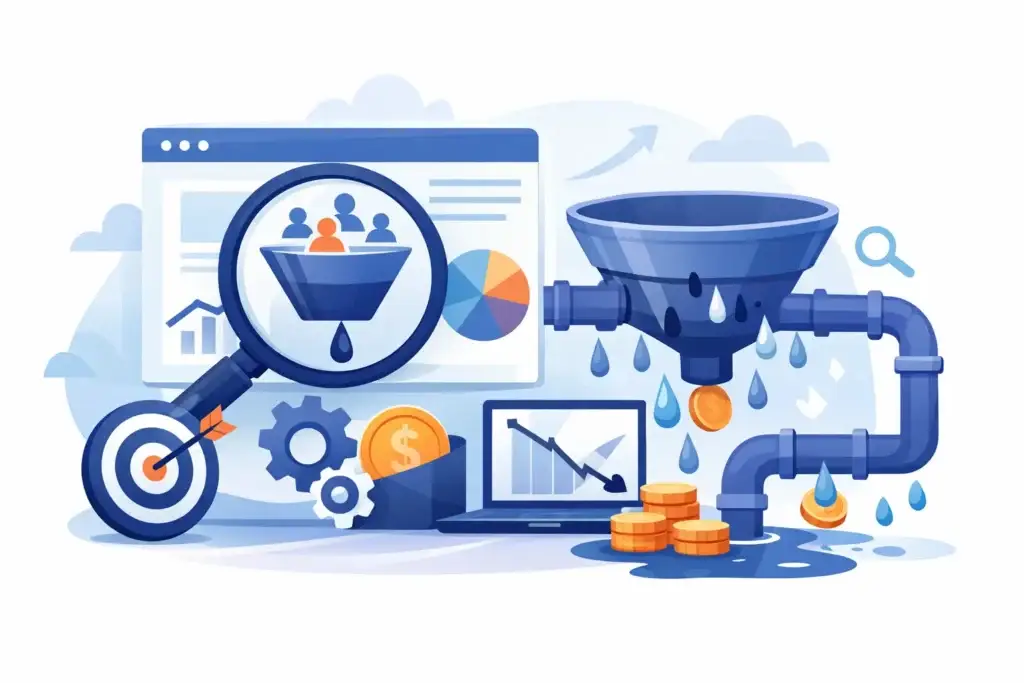
Most websites do not have a traffic problem. They have a leakage problem.
A website conversion audit helps you find where visitors lose confidence, get distracted, or hit unnecessary friction before they become leads or customers. If you are already spending on SEO, Google Ads, social media, or content, this matters even more. Paying for traffic into a weak conversion path is not growth. It is wasted budget with better branding.
For SME owners and marketing decision-makers, this is where a lot of performance stalls. Campaigns look active, impressions are fine, clicks are coming in, but inquiries stay flat. In many cases, the issue is not the channel. It is the page experience after the click.
What a website conversion audit actually covers
A proper website conversion audit is not a design critique and it is not a generic checklist copied from a blog. It is a commercial review of how well your site turns intent into action.
That means looking at the pages that matter most, usually your homepage, service pages, landing pages, pricing pages, product pages, and contact flow. The audit should examine whether the message matches the traffic source, whether the next step is obvious, and whether anything in the experience creates doubt.
The best audits also separate cosmetic issues from revenue issues. A button shade may not matter. A weak offer, unclear service scope, slow mobile load, or form that asks for too much information usually does.
Why businesses delay a conversion audit for too long
Most teams assume the problem sits at the top of the funnel. So they buy more traffic, add more content, or expand ad spend. Sometimes that works. Often it just sends more people into the same broken path.
There is also a practical reason audits get delayed. Conversion problems are rarely caused by one obvious mistake. They come from a stack of smaller issues: vague headlines, low trust, poor mobile layout, weak calls to action, thin proof, and confusing page structure. Each one looks minor on its own. Together, they reduce inquiry volume.
This is why a conversion audit is useful even when your site looks modern. Clean design can still underperform if the page does not answer buyer questions fast enough or if the user has to work too hard to understand what you do.
The highest-impact areas to review first
If you want a website conversion audit to produce business value, start with the pages closest to the money.
Traffic-heavy pages with low conversion rates should be reviewed first. So should paid landing pages, because every weakness there is amplified by media spend. Service pages matter more than many businesses think because they often rank well, attract qualified intent, and then fail to turn that attention into contact.
The first thing to assess is message clarity. Within a few seconds, a visitor should understand what you offer, who it is for, and what to do next. If your headline is broad, clever, or internally focused, that creates drag. Buyers do not reward creativity when they are trying to solve a business problem.
The second is offer strength. Some websites present services without making the next step feel worthwhile. A visitor may understand what you do but still ask, why should I contact you now? A free consultation, audit, quote, demo, or clear entry package can solve that, but only if the value is specific.
The third is trust. This is where many SME websites leave money on the table. If your site asks someone to submit a form without enough proof, expect hesitation. Proof can come from case examples, client logos, testimonials, certifications, before-and-after outcomes, or even operational transparency such as response times and process clarity. Generic claims like results-driven or customer-focused do not reduce risk.
The fourth is friction. Long forms, scattered navigation, inconsistent mobile design, slow pages, and unclear buttons all make action less likely. Friction is especially expensive on mobile, where users are less patient and have less screen space to process your offer.
How to evaluate user intent, not just page design
A useful website conversion audit should always tie page performance back to traffic intent.
Someone coming from a branded search already knows you. Someone coming from a Google Ads keyword like commercial renovation contractor or payroll software pricing is evaluating fit fast. Someone from social media may be colder and need more context. These users should not all land on the same generic page and be expected to convert at the same rate.
This is where many audits go wrong. They focus on page elements in isolation instead of asking whether the page matches the reason the visitor arrived. If the keyword suggests urgent commercial intent but the landing page opens with broad company background, that mismatch reduces conversion. If an ad promises pricing clarity but the page hides all commercial detail, that creates distrust.
Conversion is not just about page quality. It is about continuity from ad, search result, or content entry point through to the inquiry action.
What a good conversion path looks like
The strongest conversion paths are usually simple. The page leads with a clear promise, supports it with practical proof, handles common objections, and presents an obvious next step.
That does not mean every page should be short. Higher-ticket services often need more explanation. But longer pages still need structure. Visitors should be able to scan the core offer, understand outcomes, and find contact options without hunting.
A good path also respects buying stage. Some visitors are ready to inquire. Others want to compare options, review proof, or understand process first. This is why one CTA is not always enough. A call button, form, quote request, and project examples can work together if the page hierarchy is clean.
There is a trade-off here. Too few choices can underserve different intent levels. Too many choices can diffuse attention. The right answer depends on the page goal and traffic source.
The technical issues that quietly kill conversions
Not every conversion issue is messaging. Technical problems can drag down performance even when the offer is strong.
Mobile responsiveness is one of the biggest. Many sites are built desktop-first, then compressed for smaller screens without rethinking form length, image scale, button spacing, or reading flow. Since a large share of traffic now lands on mobile, this is not a minor polish item.
Page speed also matters, especially on paid traffic. Slow pages lose impatient visitors before they even evaluate your service. Heavy scripts, oversized media, and bloated templates are common culprits.
Tracking is another one. If your forms, call clicks, WhatsApp buttons, and booking actions are not tracked properly, you can end up making decisions from incomplete data. You may think a page is underperforming when the issue is measurement, or worse, think it is working when high-intent actions are being missed.
A practical audit checks both user experience and data accuracy. You need both to make sound decisions.
What to do after the audit
The value of a website conversion audit is not in the document. It is in the prioritization.
You do not need to rebuild the entire site every time you find weak points. In fact, that is often the wrong move. Start with fixes that have direct commercial impact and low implementation friction: rewrite weak headlines, tighten service positioning, shorten forms, improve CTA visibility, add proof near decision points, and align landing pages to traffic intent.
After that, test bigger changes where needed. This could mean restructuring a service page, creating dedicated pages for paid campaigns, simplifying navigation, or rebuilding mobile layouts. The right sequence depends on how much traffic the page gets, how valuable that traffic is, and how severe the conversion drop-off appears to be.
For growing businesses, speed matters. The point is not to create a perfect website. It is to remove the blockers that stop qualified visitors from taking the next step.
When a website conversion audit is worth doing now
If your business is investing in traffic but lead volume is inconsistent, now is the right time. If your sales team says leads are weak quality, now is also the right time because conversion issues often start with poor expectation-setting on the page. And if your site has not been reviewed in a year while your services, pricing, or audience have changed, the gap between what your business does and what your website communicates may already be costing you opportunities.
A conversion audit is especially useful before increasing ad budgets or launching a new SEO push. More visibility only helps if the destination is ready to convert.
At AdCendes, this is the practical lens we take with performance websites. Traffic generation and website conversion should not be treated as separate projects. They work or fail together.
The best websites are not the ones with the most effects, pages, or opinions packed into them. They are the ones that remove doubt quickly, guide action clearly, and make it easy for the right visitor to say yes.