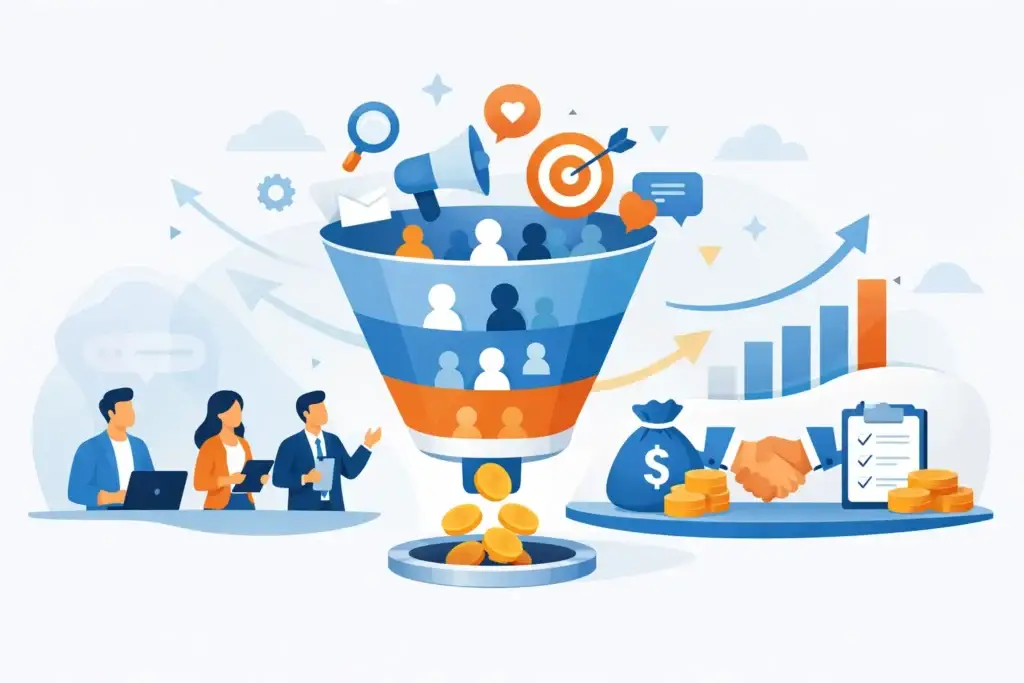
Most service businesses do not have a lead problem. They have a funnel problem. Traffic comes in from ads, search, referrals, or social, but too many prospects stall between first click and signed proposal. A strong service business funnel example makes that gap visible, then fixes it with clear steps, better follow-up, and fewer leaks.
If you run a consulting firm, clinic, agency, renovation company, legal practice, or any other service-led business, your funnel has one job – move strangers toward a real sales conversation without wasting budget or your team’s time. That sounds simple, but the details matter. A funnel that works for eCommerce usually does not work for a high-trust, high-consideration service sale.
What a service business funnel example should actually show
A useful funnel example is not just a neat diagram with awareness, consideration, and conversion written on it. It should show how real buyers move, where intent gets stronger, and what happens when they are not ready yet.
For most service businesses, the funnel starts with a problem-aware prospect. They are not browsing for entertainment. They usually want a solution to something specific: more leads, a better website, accounting help, pest control, family legal support, or an interior design quote. That means your funnel should be built around intent, speed, and trust.
A practical service business funnel example looks like this: a prospect discovers your business through Google Search, SEO content, social ads, referral traffic, or local search. They land on a page built around one offer, one audience, and one action. They either submit a form, call, message, or book a consultation. Then your follow-up process qualifies them, answers objections, and moves the right leads into a proposal or sales call. After that, your closing process and onboarding experience carry the final part of the conversion.
That is the basic shape. The performance comes from how well each stage is built.
Top of funnel – capture demand, do not spray traffic everywhere
At the top of funnel, the goal is not volume for its own sake. It is qualified attention.
For service businesses, Google Search Ads often perform well because the buyer already has intent. Someone searching “commercial cleaning service near me” or “B2B SEO agency for SaaS” is closer to action than someone casually seeing a broad social ad. SEO matters too, especially when your services involve research, comparisons, and long sales cycles. It compounds over time and helps you win demand without paying for every click.
Social platforms can still play a role, but the strategy depends on the service. Meta can work for visually driven or mass-market services. TikTok can work if the category benefits from education or demonstration. Niche channels matter when your audience lives there. If you serve Chinese-speaking buyers, platforms such as XHS can become part of the acquisition layer instead of an afterthought.
The trade-off is straightforward. Search captures existing demand faster. SEO and content build cheaper demand over time. Social can widen reach and retarget attention, but weak targeting usually creates low-quality leads. The right mix depends on your sales cycle, margin, and how clearly buyers can identify their need.
Your landing page is part of the funnel, not a design exercise
A click is not progress unless the page continues the conversation.
Too many service businesses send paid traffic to a generic homepage. That forces the prospect to figure out who you help, what you offer, and what to do next. Friction goes up. Conversion rate drops.
A better page is specific. It matches the search or ad message, explains the service in plain language, shows proof, and gives the visitor one obvious next step. That next step might be a lead form, a phone call, a WhatsApp inquiry, or a calendar booking. The format depends on the buying behavior of your audience.
If the service is urgent, calls may convert best. If it is high-ticket and more consultative, a short qualification form can save sales time. If buyers need confidence before talking, case studies, pricing signals, and testimonials should be visible without making the page feel bloated.
Middle of funnel – where most service businesses lose money
This is where a lot of campaigns look good on paper but fail commercially.
A lead comes in. Nobody responds for six hours. Or the reply is generic. Or the business asks for too much information too early. Or there is no system to separate a serious buyer from a low-fit inquiry. None of these are traffic issues. They are funnel issues.
In a strong service business funnel example, the middle of funnel is built around speed, qualification, and objection handling.
Speed matters because lead intent decays quickly. If someone fills out a form while comparing three vendors, the first helpful response often has an advantage. Qualification matters because not every lead should go to a senior salesperson or founder. Objection handling matters because many service purchases are delayed by uncertainty, not lack of interest.
This stage should answer a few practical questions quickly. Is the lead a fit? What do they need? What is the likely budget or project size? How urgent is the timeline? Which salesperson or consultant should handle it?
That process can be simple. A short intake form, an automated confirmation, and a same-day follow-up already put you ahead of many competitors. The goal is not automation for its own sake. It is consistency.
Nurture is not just email sequences
Not every lead is ready now. That does not mean they are dead.
For service businesses with longer sales cycles, nurture can include remarketing ads, educational follow-up emails, proposal reminders, and useful content tied to the exact service the lead asked about. A law firm might send a plain-language guide to common case timelines. A web development agency might send before-and-after examples and project scope ranges. A B2B consultancy might share a short audit or benchmark.
What works depends on complexity. The more expensive or disruptive the service, the more proof and reassurance buyers usually need. The less complex the service, the more speed and convenience matter.
Bottom of funnel – make the decision easy
At the bottom of funnel, your prospect is not asking, “Do I need this?” They are asking, “Why should I choose you, and what happens next?”
This is where proposal quality, pricing structure, responsiveness, and onboarding shape close rate.
A weak proposal often tries to impress with jargon. A strong one makes the decision easier. It states the problem, the scope, the timeline, the expected outcome, and the commercial terms clearly. It also reduces risk. That might mean transparent deliverables, defined reporting, client-owned ad accounts, or a phased engagement that lets the buyer start smaller.
This is especially important for SMEs. Many buyers are not just comparing expertise. They are comparing operational confidence. They want to know that the service provider will execute, communicate clearly, and not create dependency. That is one reason conversion-focused firms like AdCendes position themselves around ownership, speed, and measurable performance instead of vague creative promises.
A simple example with real funnel logic
Imagine a local accounting firm targeting growing small businesses.
At the top of funnel, it runs Google Search Ads for terms like “small business accountant” and publishes SEO content answering tax and compliance questions. The ad traffic goes to a landing page for a free consultation focused on business accounting, not personal tax.
In the middle of funnel, the lead form asks for company size, revenue range, and the main issue they need help with. Once submitted, the prospect gets an immediate confirmation and a call within one business hour. If the lead is not ready, they enter a short nurture flow with case examples, service explainers, and reminders around tax deadlines.
At the bottom of funnel, qualified leads receive a clear proposal with monthly scope, turnaround times, software coverage, and onboarding steps. There is no mystery about deliverables. There is no pricing ambiguity. The prospect either signs, asks a final question, or exits. That clarity improves both conversion rate and sales efficiency.
The same structure can be adapted for an interior design studio, dental clinic, HR consultancy, or marketing agency. The channels and proof points change. The funnel logic does not.
How to tell if your funnel is broken
You usually do not need more traffic first. You need better diagnosis.
If click volume is high but inquiries are weak, your offer or landing page is likely off. If leads come in but few become meetings, your follow-up is too slow or too vague. If meetings happen but proposals do not close, the issue is probably trust, pricing fit, or poor sales structure. If close rates are decent but volume is low, then it may be time to expand channels.
That is why reporting should be tied to the full path, not just top-line lead counts. A cheap lead that never closes is not efficient. A more expensive lead that becomes a profitable client often is.
Build the funnel around decisions, not marketing jargon
The best service funnels are not flashy. They are disciplined.
They match channel to buyer intent. They send traffic to focused pages. They respond quickly. They qualify without adding friction. They nurture only when necessary. They make the final decision easy with proof, clarity, and a low-chaos buying experience.
If your current setup feels scattered, start with one service, one audience, and one conversion action. Tighten that path before adding more channels. A service business does not scale by being everywhere. It scales by turning the right attention into predictable revenue, one clean stage at a time.