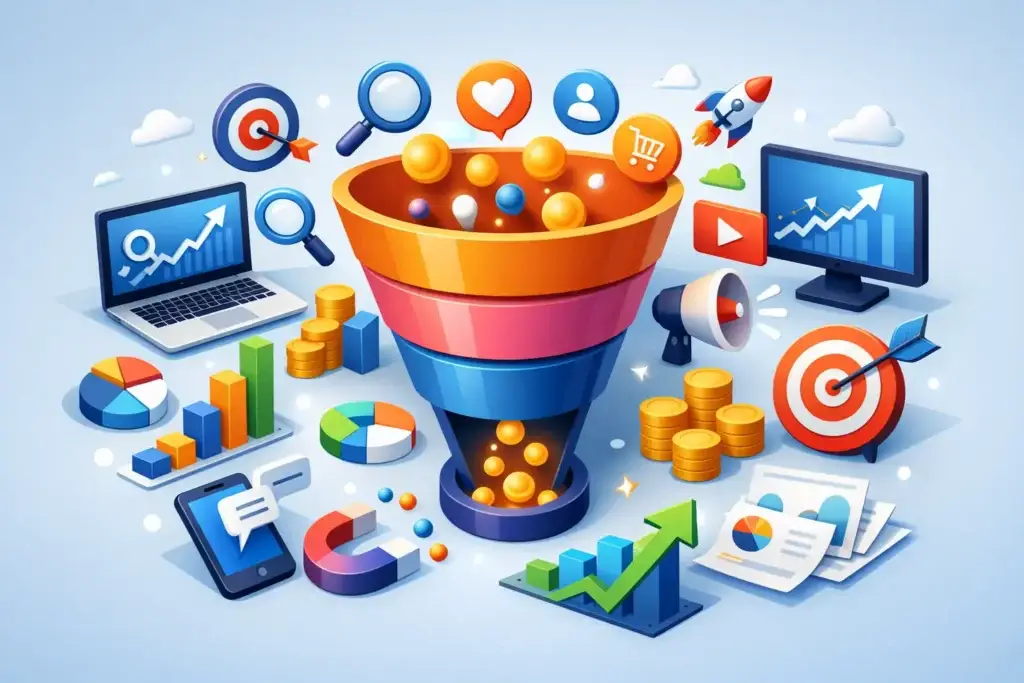
Most SMEs do not have a traffic problem. They have a coordination problem. Paid campaigns bring clicks, SEO brings visits, social media gets attention, and the website sits in the middle trying to turn that activity into revenue. Without a full funnel digital marketing strategy, those parts stay disconnected and performance stalls.
That is why so many businesses feel like marketing is busy but not productive. One vendor runs Google Ads, another posts on social media, someone updates the website when there is time, and reporting shows channel metrics instead of business outcomes. The fix is not more activity. The fix is building the funnel properly and managing it as one system.
What a full funnel digital marketing strategy actually means
A full funnel digital marketing strategy is a plan for moving people from first awareness to inquiry, purchase, and repeat business using the right channels at the right stage. It is not about being everywhere. It is about making each channel do a specific job and making handoffs between channels measurable.
At the top of the funnel, the goal is visibility and audience capture. This is where SEO, educational content, social media, short-form video, display awareness, and platform-specific discovery channels can help. For some businesses, TikTok or Xiaohongshu may create attention faster than search. For others, search demand is already there and Google should get more budget.
In the middle of the funnel, prospects are comparing options. They are checking your service pages, reading reviews, looking at case studies, and deciding whether your business feels credible. This is where content quality, landing page clarity, remarketing, and reputation management matter. If the middle is weak, top-of-funnel investment leaks.
At the bottom of the funnel, people are ready to act. They search with higher intent, submit forms, call, message, or add products to cart. This is where Google Search Ads, conversion-focused landing pages, strong offers, and clean tracking usually produce the fastest return.
After conversion, the funnel is not finished. Follow-up email, retargeting, upsells, repeat purchase campaigns, and customer reviews all extend customer value. A lot of SMEs ignore this stage and keep paying to acquire first-time customers when they could be increasing profit from existing ones.
Why SMEs struggle to execute a full funnel digital marketing strategy
The common issue is fragmentation. Channels are managed separately, so nobody owns the full buyer journey. One person reports impressions, another reports rankings, another reports cost per click, but no one is accountable for lead quality or sales contribution.
The second issue is timing. SEO takes time. Paid ads move faster. Social content may help trust but not produce direct leads right away. If expectations are wrong, business owners either cut long-term channels too early or overinvest in quick wins that stop the moment ad spend drops.
The third issue is weak conversion infrastructure. Even good traffic underperforms when the landing page is vague, the form is too long, the offer is generic, or the tracking is incomplete. If you cannot see where leads come from and what they do next, decision-making becomes guesswork.
A practical strategy solves these problems by tying channels to funnel stages, setting realistic time horizons, and building around measurable actions.
How to build a full funnel digital marketing strategy
Start with revenue goals, not channel preferences. If the target is 30 qualified leads per month, work backward. How many landing page visits are needed? What conversion rate is realistic? How much search demand already exists? How much demand needs to be created through content or social reach?
This matters because channel planning without volume assumptions usually leads to underperformance. A business may say it wants SEO, Meta Ads, and TikTok, but if the site converts poorly and the sales team responds slowly, adding channels just multiplies inefficiency.
1. Map the funnel to buyer intent
Different audiences move differently. A B2B service buyer may take weeks to compare providers. A retail buyer may convert the same day. An interior design prospect may spend time on visual platforms before searching on Google. A strategy only works when it reflects real buying behavior.
Top-of-funnel messaging should answer broad problems and create relevance. Middle-of-funnel assets should reduce doubt. Bottom-of-funnel pages should make action easy and specific. That sounds simple, but many businesses use the same generic message everywhere and expect different results.
2. Prioritize channels by speed and payoff
If immediate lead flow is the priority, high-intent search usually deserves early budget. Google Search Ads can capture people already looking for a solution. If long-term cost efficiency matters, SEO and content should run alongside paid search, not after it. If audience discovery is crucial, paid social and short-form content may play a bigger role.
There is always a trade-off. Paid media gives speed but depends on budget. SEO compounds over time but takes patience and operational consistency. Social can support trust and reach, but not every platform suits every business. A strong plan makes these trade-offs explicit instead of pretending every channel should be scaled at once.
3. Fix the conversion layer before scaling traffic
Your website is not a brochure in a full funnel digital marketing strategy. It is the conversion layer. That means landing pages need clear positioning, proof, service relevance, mobile speed, and direct calls to action.
For lead generation, every click should land on a page built for one decision. For ecommerce, product pages, collections, checkout flow, and abandonment recovery matter more than vanity traffic. For local services, location intent, trust signals, and response speed often influence performance as much as ad quality.
This is where many campaigns break. Businesses buy traffic before fixing the page experience. Then they blame the platform.
4. Set tracking around business outcomes
Track forms, calls, purchases, booked appointments, chat starts, and qualified lead status. If possible, connect marketing data to pipeline or sales outcomes. A cheap lead is not useful if it never converts.
Basic reporting should show more than clicks and impressions. You need cost per lead, conversion rate by landing page, assisted conversions, and channel contribution by funnel stage. When the numbers are visible, budget decisions get easier and internal trust improves.
What the channel mix can look like in practice
For a service business, a practical mix often starts with Google Search Ads for bottom-funnel demand, SEO for long-term search visibility, and conversion-focused landing pages to increase inquiry volume. Remarketing then helps bring back visitors who did not convert the first time.
For brands with visual products or stronger lifestyle positioning, Meta Ads and short-form video may support discovery earlier in the funnel. If the audience includes Chinese-speaking consumers, Xiaohongshu can be more than an awareness channel. It can influence trust, consideration, and brand preference before buyers ever search on Google.
For reputation-sensitive categories, reviews and social proof deserve more attention than most owners expect. Prospects in the middle of the funnel often compare based on perceived reliability, not just price. A weak reputation layer quietly reduces conversion across every channel.
What good execution looks like month to month
A strategy is only useful if it survives operations. In practice, monthly execution should include budget shifts based on lead quality, landing page testing, search query reviews, content updates, and clear reporting tied to outcomes.
That does not mean changing everything every week. Over-optimization is real. Some channels need time to stabilize. Some pages need enough traffic before a test means anything. But there should always be active management, not passive maintenance.
This is why businesses often do better with one accountable growth partner than several disconnected specialists. When paid media, SEO, content, website changes, and reporting are coordinated, decisions happen faster and waste gets spotted earlier. That operating model is often more valuable than any single channel tactic.
AdCendes works best in that environment because SMEs usually do not need more marketing theory. They need execution across channels that can be turned on quickly, measured clearly, and improved without handoff delays.
When to simplify instead of expanding
Not every business needs a broad funnel from day one. If your offer is proven and search demand exists, starting with bottom-funnel channels and a strong landing page may be the smartest move. If your category is unfamiliar or highly competitive, you may need more top- and middle-funnel investment before conversion rates improve.
The point is not to build a complicated system for the sake of it. The point is to create enough coverage across the funnel that demand generation, demand capture, and conversion support each other.
A full funnel digital marketing strategy works when each channel has a job, each stage has a measurable objective, and the website is treated as part of sales, not an afterthought. If your marketing feels active but disconnected, that is usually the first place to look. Start by fixing the handoffs, and growth becomes a lot easier to scale.
Related reading: If you want to go deeper, read a full-funnel marketing strategy that converts.