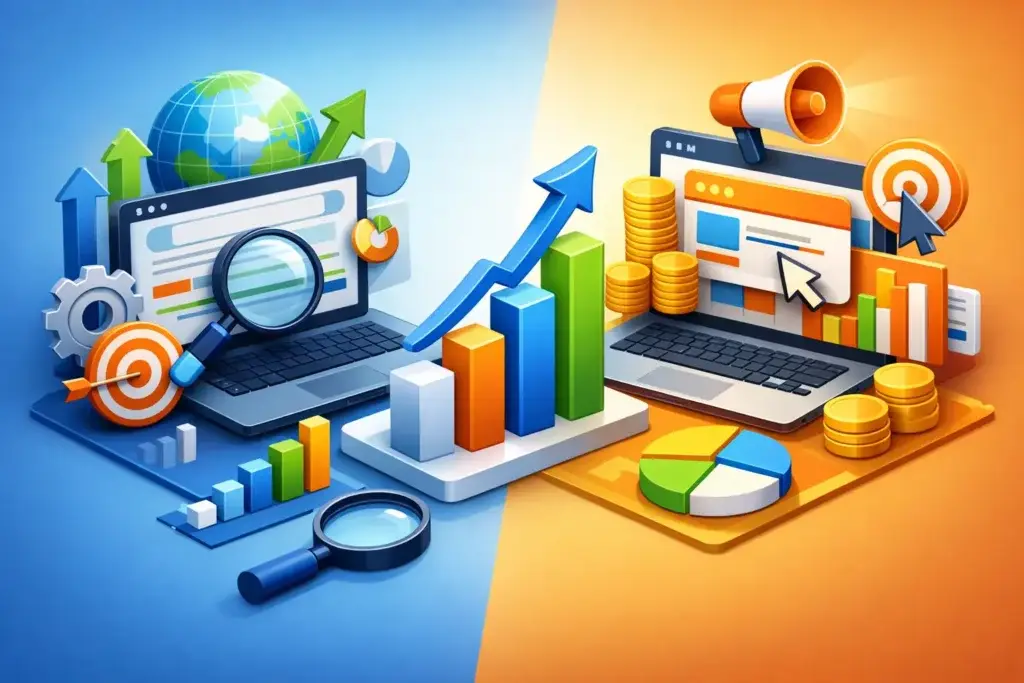
If you need leads this month, not just traffic someday, the seo vs sem question stops being academic pretty quickly. Most SMEs do not have the budget to waste on channel confusion. They need to know what brings demand in now, what compounds over time, and what mix makes commercial sense.
The short answer is simple. SEO helps your business earn visibility in organic search results. SEM usually refers to paid search, where you bid to appear for high-intent keywords. One builds an asset. The other buys speed. Good growth planning usually needs both, but not in equal proportions and not at the same stage of the business.
SEO vs SEM: the real difference
SEO is the work that improves your rankings in unpaid search results. That includes technical fixes, content strategy, on-page optimization, internal structure, and authority building. The goal is to get found consistently without paying for every click.
SEM is paid search advertising, most commonly through platforms like Google Ads. You choose target keywords, write ads, set bids, and pay when someone clicks. The goal is immediate visibility for search terms that signal buying intent.
That difference sounds obvious, but the commercial impact is where business owners usually get tripped up. SEO is slower to mature, less predictable in the short term, and stronger as a medium-term growth asset. SEM is faster to launch, easier to test, and more direct if you need inquiries now. Neither is automatically better. The right choice depends on timing, margins, competition, and how ready your website is to convert.
When SEO makes more sense
SEO is a strong fit when your business has a clear service offer, buyers actively search for it, and you can commit to a consistent timeline. It works especially well for businesses that want to reduce dependency on paid media over time.
If you run an interior design firm, legal practice, software company, or specialty service business, search behavior tends to be steady. People look for solutions, compare providers, and often research before contacting anyone. In those cases, strong organic visibility can become a durable lead source.
The advantage of SEO is that the return can improve over time. A well-ranked page can bring in leads for months with no per-click charge. Your cost does not rise every time someone visits. That creates efficiency once momentum builds.
The trade-off is speed. SEO rarely fixes a pipeline problem in the next two weeks. It also depends on market conditions you do not fully control. If your competitors have been investing in content and authority for years, catching up takes work. And if your site is weak, ranking alone will not solve conversion issues.
SEO also requires patience from the business side. Not blind patience, but realistic expectations. You should expect measurable progress in indexing, rankings, traffic quality, and lead intent before you expect dominant results across a full keyword set.
When SEM makes more sense
SEM is the practical choice when time matters. If your sales team needs fresh inquiries, your new location has to generate demand, or you are testing a new service line, paid search gives you faster feedback.
That speed matters because it shortens the gap between budget spent and market response. You can launch campaigns quickly, see which keywords convert, measure cost per lead, and adjust based on actual demand instead of assumptions.
For SMEs, that makes SEM useful in three common situations. First, when the business needs leads now. Second, when the website already converts reasonably well and traffic is the main bottleneck. Third, when search intent is strong enough that buyers are close to action.
The downside is straightforward. Once you stop paying, visibility stops. Costs can also climb fast in competitive sectors. A high click-through rate means very little if the traffic does not convert profitably. SEM rewards disciplined execution, not just ad spend.
This is where many businesses get disappointed. They think paid search is a switch you flip for instant sales. In reality, SEM still depends on offer clarity, landing page quality, keyword targeting, conversion tracking, and follow-up speed. Fast traffic does not guarantee good outcomes.
SEO vs SEM on cost, speed, and control
If you compare seo vs sem from a business operations standpoint, three factors matter most: how fast you need results, how much control you want, and how your customer acquisition economics work.
SEO usually has lower marginal traffic cost over time, but a higher patience requirement. You invest upfront in site quality, content, and authority. Results are less immediate, but they can keep paying back after the initial work is done.
SEM gives you more direct control. You can decide which keywords to target, which locations to serve, what message to test, and when to scale up or down. That level of control is valuable, especially when cash flow and lead volume need close management.
But control does not always mean efficiency. If the keyword market is expensive and your average deal size is modest, paid search can become hard to sustain. On the other hand, if one closed sale covers weeks of ad spend, SEM can be the most sensible growth lever in the room.
This is why channel decisions should not be made in isolation. You have to look at lead value, close rate, sales cycle length, and website conversion rate. Without that context, seo vs sem turns into a marketing opinion contest instead of a commercial decision.
Why the best answer is often both
For most growth-focused businesses, SEO and SEM work best together because they solve different parts of the same problem.
SEM captures demand immediately. SEO strengthens long-term visibility and reduces dependence on paid traffic. Running both also creates useful feedback loops. Paid search tells you which keywords convert, which offers attract clicks, and which landing page messages produce inquiries. That data can inform your SEO content strategy. At the same time, strong organic pages can improve paid search performance by reinforcing credibility and increasing brand familiarity.
There is also a practical budget argument for using both. Relying only on SEO can leave you waiting too long for pipeline impact. Relying only on SEM can keep acquisition costs high forever. A combined approach lets you buy speed while building an asset.
That is often the right model for SMEs that need monthly lead flow but do not want to stay dependent on ad spend as their only source of demand.
How to decide what to prioritize first
If your business is early-stage, launching something new, or dealing with an urgent lead gap, start with SEM. It gets you into the market faster and gives you clearer data. Just make sure your landing pages, tracking, and sales follow-up are in place before you spend heavily.
If your business already has stable operations and a service that buyers search for consistently, invest in SEO as early as possible. The earlier you start, the earlier you build compounding visibility. Waiting until you are tired of ad costs usually means starting late.
If budget is limited, avoid splitting too thinly across everything. Prioritize based on the business bottleneck. If the problem is no immediate demand, SEM should lead. If the problem is rising acquisition cost and weak long-term visibility, SEO deserves stronger investment.
A practical approach is to let one channel carry the short-term load while the other develops in the background. That is usually more effective than forcing a perfectly even split that underfunds both.
Common mistakes businesses make
One common mistake is treating SEO as free traffic. It is not free. You pay in time, expertise, content production, and technical execution. The fact that you do not pay per click does not mean the channel runs itself.
Another mistake is expecting SEM to fix a weak website. Ads can send traffic, but they do not repair unclear offers, slow pages, poor forms, or weak trust signals. If your conversion path is broken, more clicks just make the inefficiency more expensive.
A third mistake is measuring the channels by the wrong timeline. SEO should not be judged like a two-week ad test. SEM should not be judged like a long-term brand asset. Different channels deserve different expectations.
At AdCendes, this is usually where the conversation gets more practical. The question is not whether a channel sounds good. The question is whether it can produce measurable business movement based on your goals, budget, and current site performance.
The better question than SEO vs SEM
The better question is not which channel wins. It is what your business needs right now, and what it will need six months from now.
If you need speed, buy speed. If you need staying power, build it. If you need both, plan both properly instead of hoping one channel will do the whole job.
Good marketing is rarely about picking sides. It is about matching the channel to the growth stage, the economics, and the actual demand in your market. Start there, and the right answer becomes a lot less theoretical.
Related reading: If you want to go deeper, read SEO vs Google Ads for small business.