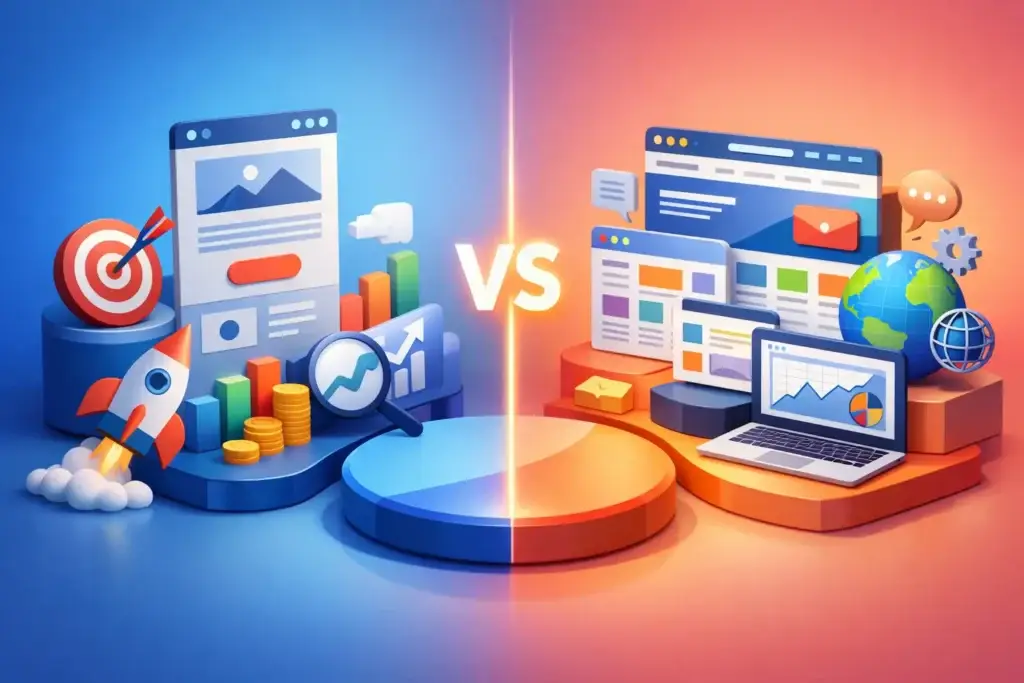
If you are deciding between a landing page vs full website, the real question is not which one is better. It is which one will produce the next business result you actually need. For some companies, that means leads this month. For others, it means stronger search visibility, better trust, and a structure that can support growth across multiple services or products.
A lot of SMEs get this wrong because they treat the decision like a design choice. It is not. It is a commercial decision tied to traffic source, sales cycle, offer complexity, and budget. Build the wrong asset, and you either waste money on pages nobody needs or send paid traffic to a site that is too broad to convert.
Landing page vs full website: the core difference
A landing page is built to get one action from one audience with as little friction as possible. That action could be a form submission, a call, a booking, a quote request, or a purchase. The page usually focuses on one offer, one campaign angle, and one conversion path.
A full website does more than push one action. It explains your business, organizes multiple services or product lines, supports trust-building, and creates a structure people can browse. It also gives search engines more content to index, which matters if you want long-term visibility.
Neither format is automatically the smarter investment. A landing page is usually better for speed and conversion focus. A full website is usually better for brand depth, SEO potential, and operational scale.
When a landing page is the better business move
If you are running paid ads and need leads quickly, a landing page is often the right place to start. Paid traffic works best when message match is tight. Someone clicks an ad for commercial cleaning in Chicago, and they land on a page about commercial cleaning in Chicago, not a generic homepage with six menu options and three unrelated services.
That tighter experience usually improves conversion rate because the visitor does not have to figure out what you do or where to click next. The page tells them what the offer is, who it is for, why they should trust you, and what to do now.
This is especially useful for businesses with a clear, high-intent offer. Think renovation firms promoting free consultations, clinics promoting a specific treatment, SaaS companies pushing demos, or education providers filling seats for one program. In these cases, focus beats breadth.
A landing page also makes sense when budget is limited. If the immediate goal is lead generation, it is often smarter to invest in one page that is built to convert rather than spend more on a larger site before demand is proven.
That said, landing pages have limitations. They are not ideal if your audience needs to compare multiple services, learn your process in detail, review past work, or browse before taking action. They also do less for organic search unless they are part of a broader content and SEO setup.
When a full website is the better long-term asset
A full website makes more sense when your business is not selling just one thing to one type of buyer. If you offer multiple services, serve different customer segments, operate in several locations, or need to establish trust before someone contacts you, a bigger structure is usually justified.
A website gives you room to answer the questions buyers ask before they convert. Who are you? What industries do you serve? How does your process work? What results have you delivered? What makes your service different from the ten other companies they are comparing?
This matters even more in categories where trust and credibility influence the sale. Legal, healthcare, B2B services, higher-ticket home services, and specialized consulting often benefit from a proper website because buyers need more proof before they act.
A full website is also the stronger option if SEO is part of your growth plan. Organic search rarely performs well on a single-page setup alone. You need service pages, location pages, supporting content, and a logical site structure. That does not generate leads overnight, but it can reduce your dependence on paid traffic over time.
The trade-off is that a full website takes more planning, more content, and more upkeep. If it is built without a clear conversion strategy, it can become expensive digital furniture – attractive, broad, and underperforming.
Landing page vs full website for paid ads, SEO, and trust
The best format often depends on where your traffic is coming from.
For paid ads, landing pages usually win. Search and social campaigns perform better when the post-click experience is highly specific. Fewer distractions, stronger message match, and a clear call to action generally lead to better conversion efficiency.
For SEO, full websites usually win. Search engines need structure and topical depth. If you want to rank for multiple services or target different search intents, one page is rarely enough.
For trust, it depends. A strong landing page can build enough confidence to convert cold traffic if the offer is simple and the proof is clear. But if the sale is more complex or expensive, a full website gives buyers more ways to validate your business before they reach out.
This is why the smartest setup for many SMEs is not one or the other forever. It is a full website for credibility and SEO, paired with dedicated landing pages for campaigns.
The cost question most businesses ask too late
Many companies compare landing page vs full website based only on build price. That is too narrow.
A landing page is cheaper to launch, but only if it converts well enough to justify the traffic spend behind it. A full website is more expensive upfront, but it may lower acquisition costs later if it improves trust, supports SEO, and makes your whole digital presence easier to manage.
The better question is this: what is the cost of delay, and what is the cost of building the wrong thing first?
If you need leads now and wait months for a full website before testing demand, that delay has a cost. If you launch a single landing page for a business with five services and a long consideration cycle, the weak fit has a cost too.
The asset should match the growth stage. Early-stage businesses often need speed and proof of traction. Established businesses usually need structure, visibility, and a stronger digital sales foundation.
How to choose the right option for your business
Start with your primary objective for the next 90 days. If the answer is lead generation from one service or campaign, a landing page is usually the practical choice. If the answer is building a credible online presence that can support multiple channels and future growth, a full website is likely the better investment.
Then look at your offer complexity. A simple offer with clear intent can convert on one page. A business with layered services, long sales cycles, or multiple decision-makers usually needs more depth.
Traffic source comes next. Paid campaigns benefit from focused pages. SEO, branded search, referral traffic, and broader discovery often benefit from a complete website.
Finally, consider internal capacity. A full website is not a one-time project if you want it to perform. It needs content, updates, conversion tracking, and ongoing refinement. If you are not prepared to manage that yet, starting smaller can be the more disciplined move.
A practical way to think about the decision
If your business is trying to validate demand, launch a new offer, or generate leads quickly, start with a landing page. If your business already has traction and now needs a stronger foundation for SEO, authority, and multi-service growth, invest in a full website.
If you can do both, do both with clear roles. Let the website carry the brand, service depth, and search visibility. Let the landing pages carry campaign performance.
That is usually where the best results come from – not from choosing the bigger asset or the cheaper one, but from choosing the one that matches how your customers actually buy.
For growth-focused SMEs, the right web presence is not about having more pages. It is about removing friction between traffic and action. Build for that, and the format becomes much easier to decide.