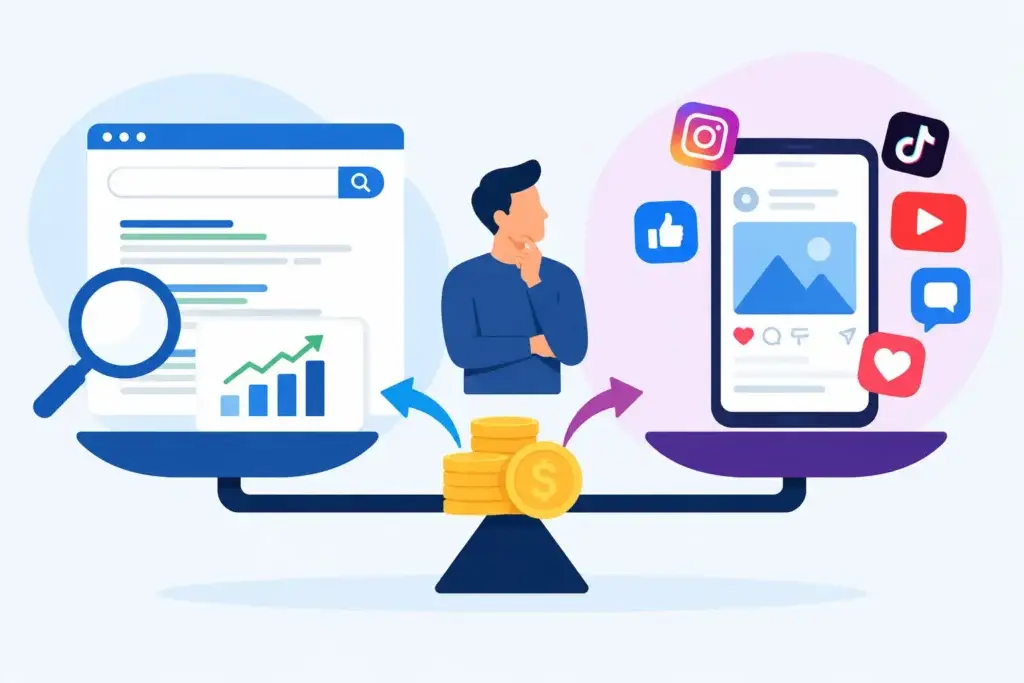
A homeowner who searches “renovation contractor near me” is not in the same position as someone watching a kitchen makeover video between meetings. That is the practical difference behind search versus social. One channel usually captures existing demand. The other creates attention, interest, and familiarity before demand becomes urgent. For an SME with a finite marketing budget, treating them as interchangeable is an expensive mistake.
The better question is not which channel is universally better. It is which channel can move your next business objective, with a sales process and measurement setup you can actually manage.
Search Versus Social Starts With Buyer Intent
Search marketing works when people know they have a problem and are actively looking for a solution. They may search for a service, compare providers, check prices, or look for a location nearby. Google Search Ads and SEO put your business in front of that demand at the point of intent.
For service businesses, this can produce a relatively direct path from keyword to inquiry. A company searching for “outsourced HR services” or “commercial cleaning quote” has already done part of the qualification work. Your job is to match the search with a relevant offer, a credible landing page, and a fast response process.
Social platforms work differently. People do not usually open TikTok, Instagram, Facebook, or Xiaohongshu intending to request a quote. They open these platforms to consume content, follow people, find ideas, or stay entertained. A strong social campaign earns attention first, then turns that attention into a visit, lead, or future branded search.
This makes social especially useful when buyers need education, visual proof, or repeated exposure before they act. An interior designer can show before-and-after transformations. A restaurant can make a menu item look worth trying. A SaaS business can demonstrate a frustrating operational problem and explain a better workflow. The person seeing the ad may not convert today, but the campaign can create demand that did not exist five minutes earlier.
When Search Should Get More Budget
Search deserves priority when the business needs leads soon and there is clear evidence that customers are already searching for the offer. It is often the right starting point for urgent, high-intent categories such as repair services, legal consultations, recruitment support, B2B solutions, clinics, and home services.
It is also the sensible first move when you have limited creative capacity. A search campaign still needs strong ad copy and landing pages, but it does not require a constant stream of new videos, images, creator partnerships, or trend-aware content. You are meeting people who already raised their hand.
That does not mean every search campaign will perform. High-intent keywords can be competitive and costly. Broad keyword targeting can attract poor-fit clicks. A weak landing page can waste a perfectly good ad budget. If you pay for traffic but make visitors hunt for your services, pricing cues, credibility, or contact details, the channel will look worse than it is.
Before scaling search spend, make sure your offer and conversion path are ready. The page should match the search term, state what happens next, and remove avoidable friction. Track calls, form submissions, booked appointments, and qualified opportunities rather than celebrating click volume.
SEO supports the same demand-capture strategy over time. Paid search can activate quickly, while SEO builds non-paid visibility for relevant service pages and useful content. For many SMEs, running both creates a more stable position: immediate lead generation from ads and lower-cost long-term visibility from organic search.
When Social Should Get More Budget
Social should take a larger role when the market does not yet understand why it needs your product, when your offer is visually demonstrable, or when trust must be built before a buyer will speak to sales.
Consider a premium renovation firm. A homeowner may eventually search for contractors, but the decision often starts months earlier with inspiration, style preferences, and concerns about workmanship. Social content can establish taste, demonstrate project management, and show real outcomes before the buyer ever types a search query.
The same applies to new categories and differentiated products. If your service is unfamiliar, nobody can reliably search for it by name. Social lets you frame the problem in plain language and show the result. It can also reach audiences based on interests, behavior, job roles, or communities that are hard to capture through keywords alone.
The trade-off is that social demands better creative discipline. Generic brand graphics and polished-but-empty messaging rarely sustain performance. You need clear hooks, proof, customer language, useful demonstrations, and a process for testing variations. A campaign that has not been refreshed for months can lose attention even if the targeting is sound.
Social lead forms can generate volume quickly, but volume is not the same as revenue. A low-friction form may produce names and phone numbers from people who are curious but not ready. Build qualification into the form where appropriate, follow up quickly, and report on contact rate, appointments, and sales outcomes. Otherwise, you may optimize for cheap leads that your team cannot close.
Use the Sales Cycle to Decide the Mix
The shortest path to an answer is to map your buyer journey. Ask when customers recognize the problem, what they search for, what proof they need, and how long it takes to make a decision.
If the need is urgent and the purchase is practical, search commonly carries more of the budget. A broken air conditioner, an expiring insurance policy, or an immediate staffing gap creates active demand. The buyer wants options now.
If the purchase is considered, visual, or identity-driven, social may need to do more early work. Furniture, design services, specialty food, education, beauty, and lifestyle products often benefit from discovery before comparison. B2B businesses with long sales cycles can use social to keep their expertise visible while search captures prospects who are ready to evaluate vendors.
A useful starting model is not a fixed percentage. It is a sequence. Fund the channel that can create qualified conversations now, then use the second channel to solve the constraint holding growth back. If search produces leads but conversion rates are low, improve landing pages and sales follow-up before expanding reach. If search volume is capped, use social to create more awareness and retarget engaged audiences.
Measurement Is Where Most Channel Decisions Fail
Search versus social becomes confusing when each platform is judged by its own dashboard. Search may claim a conversion after a single click. Social may influence a buyer who later searches your brand and converts through Google. If you only look at last-click attribution, social can appear weaker than it really is.
At the same time, do not use awareness as an excuse for vague reporting. Every channel needs a defined job and a measurable signal. For search, that may be qualified calls, quote requests, cost per opportunity, and revenue. For social, it may include video engagement and landing page visits, but it should ultimately connect to leads, pipeline, repeat visits, branded search growth, or sales.
Use consistent tracking across ads, forms, calls, CRM stages, and sales outcomes. Keep ad accounts in your ownership. Review which campaigns produce qualified opportunities, not just the lowest platform-reported cost per lead. This is how you avoid shifting budget based on surface-level metrics.
A Practical Allocation for SMEs
If you are starting from zero, begin with the channel closest to revenue. For a business with existing search demand, that is often Google Search Ads paired with a focused landing page. Once the campaign produces reliable signals, add social retargeting to stay visible to visitors who did not inquire.
Then test prospecting on social with a controlled budget. Use a specific offer or proof point, not a broad claim about being the best. Compare lead quality and sales progression against search over a meaningful period. A one-week test is rarely enough for a considered purchase, but a three-month campaign with no qualified activity is a signal to change the message, audience, offer, or budget allocation.
For businesses with low search volume or a new offer, reverse the order. Start with social content and paid distribution to educate the market, capture engagement, and build remarketing audiences. Keep a search presence for the relevant intent that does exist, then expand as branded and category searches grow.
AdCendes approaches channel planning as one operating system, not a fight between separate vendors. The goal is to make each channel do the work it is best suited for, while reporting on the business result they produce together.
Your next budget decision should be simple: put money where buyer intent, your offer, and your ability to follow up are strongest. Then test the adjacent channel with clear measurement. The winning strategy is not search or social. It is knowing what each one must deliver before you ask it to scale.