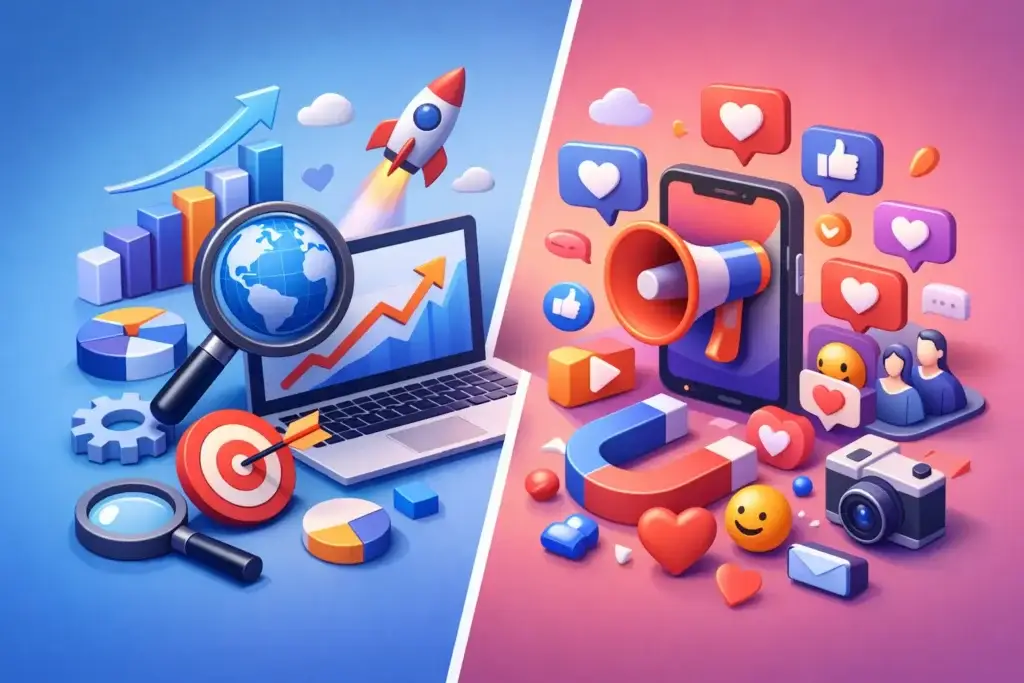
If you are deciding between seo versus social media marketing, the real question is not which one is better in general. It is which one fits your sales cycle, budget, margins, and growth timeline. For most small and mid-sized businesses, the wrong choice is not picking one channel over the other. It is expecting one channel to do a job it was never built to do.
A plumbing company that needs inbound leads this month should not rely on organic Instagram content alone. A new lifestyle brand that needs attention and audience feedback may not get enough traction from SEO in its first few months. The channel has to match the business objective.
SEO versus social media marketing: the core difference
SEO captures existing demand. Social media creates attention and helps shape demand.
That difference matters because buyer intent affects cost, lead quality, and how quickly you see results. When someone searches for “emergency electrician near me” or “best payroll software for small business,” they already have a problem and are looking for a solution. SEO helps your business appear when that intent is high.
Social media works differently. Most users are not actively searching for your service when they open Instagram, TikTok, Facebook, or LinkedIn. They are scrolling, comparing, watching, and reacting. Good social media marketing interrupts that behavior in the right way and turns passive attention into interest over time.
So if your business depends on high-intent leads, SEO often has stronger commercial efficiency. If your business needs awareness, community, repeat exposure, or visually driven persuasion, social media can move faster.
Where SEO wins
SEO is strong when your customers already know they need something. Local services, B2B providers, healthcare practices, legal firms, home services, software companies, and many professional services benefit from showing up in search when people are ready to evaluate options.
The biggest advantage of SEO is compounding visibility. A well-ranked service page or useful article can bring in traffic and leads long after it is published. That does not mean SEO is free or automatic. It takes technical work, content planning, page optimization, and patience. But once momentum builds, the channel becomes more efficient than constantly paying for attention.
SEO also gives you stronger alignment with conversion intent. Search traffic usually lands on a page built for a purpose: book a call, request a quote, compare services, or make a purchase. That makes measurement more straightforward. You can track rankings, organic traffic, lead forms, calls, booked meetings, and revenue contribution with less guesswork.
There are trade-offs. SEO is slower at the start, especially in competitive industries. If your website is weak, your technical setup is messy, or your market is crowded with established players, you may wait months before seeing meaningful gains. Businesses that need immediate lead flow should not treat SEO as a short-term fix.
Where social media marketing wins
Social media marketing is strong when trust, visual proof, or brand personality affects buying decisions. Restaurants, retail brands, interior designers, fitness studios, beauty businesses, coaches, creators, and community-driven brands often benefit from regular social presence because buyers want to see how the brand looks, sounds, and behaves before they buy.
It also helps when your product is not yet being actively searched at scale. If people do not know your offer exists, search demand may be limited. Social content can introduce the problem, frame the solution, and make your business memorable before buyers ever go to Google.
Another advantage is speed. A strong paid or organic social campaign can generate attention, clicks, and direct inquiries quickly. You can test angles fast, get audience feedback, and adjust creative without waiting months for rankings to move. For businesses launching something new, that speed has real value.
The downside is durability. Social results are often less stable. A strong post can perform for a few days, then disappear. Platform reach changes. Audience behavior shifts. What worked last month may stall this month. Unless you are consistently producing useful content or running paid distribution, momentum fades.
SEO versus social media marketing for lead generation
If your main KPI is qualified leads, SEO usually produces higher-intent inbound traffic. That does not guarantee higher volume early on, but the lead quality tends to be stronger because the user is actively searching.
Social media can generate leads too, but the path is often less direct. Users may discover you on one platform, watch your content for weeks, click your profile later, and convert after several touchpoints. That can still be profitable, but attribution gets messier and the sales cycle may depend more on repeated exposure.
For service businesses, this distinction is practical. A founder looking for fast quote requests from local buyers should usually treat SEO as a core channel and social media as support. A brand trying to build audience trust, showcase work, and stay visible between buying cycles should invest in social alongside search.
Which channel gives better ROI?
There is no universal winner because ROI depends on timeline and execution quality.
In the short term, social media often looks better because you can launch quickly and get visible activity. If you need traffic, awareness, or inquiries within weeks, social has the advantage. But if that performance depends on constant posting, paid boosts, or creative churn, the long-term economics can get expensive.
SEO often looks weaker in the first few months because the work happens before the payoff. You improve site structure, create useful pages, fix technical issues, and build topical relevance. The returns come later. Once the channel starts producing consistent traffic and leads, ROI can become much stronger because each additional click is not purchased one by one.
This is why smart businesses compare channels by time horizon, not just monthly spend. If you only need immediate traction, social may win. If you want an asset that keeps producing demand, SEO often wins.
The best choice depends on your business model
A local service business with clear search demand should usually prioritize SEO early. If people are already looking for what you sell, visibility in search is too valuable to ignore.
An ecommerce or lifestyle brand may lean harder into social first, especially when visual storytelling influences conversion. Product discovery happens naturally on social platforms in a way it does not on search.
A B2B company often needs both, but not in equal weight. SEO can capture intent around service terms and problem-aware searches, while social supports authority, remarketing, and trust-building. In these cases, LinkedIn content, case studies, and founder visibility can strengthen the conversion rate of search traffic rather than replace it.
If you are targeting multilingual or culturally specific audiences, platform selection matters even more. Search behavior and platform preference vary by audience segment. That is one reason integrated execution matters. The right mix is rarely just about channel popularity.
Why most SMEs should stop treating this as an either-or choice
The better question is how SEO and social media marketing can work together without wasting budget.
A practical setup looks like this: SEO captures people already looking, social media builds familiarity and proof, and your website converts both. If one part is weak, the others underperform. Search traffic landing on a thin website will not convert well. Social traffic sent to a generic homepage will leak. Good channel strategy depends on a usable site, clear offers, and consistent tracking.
This is where many SMEs get stuck. They hire one vendor for content, another for ads, and a freelancer for the website, then wonder why reporting is vague and results feel disconnected. Channel coordination is not a luxury. It is basic performance management.
At AdCendes, this is usually the point we address first with clients. Not by selling every channel at once, but by matching the right channel mix to the business goal, the lead timeline, and the current state of the website.
How to decide what to prioritize first
Start with three questions. Are people already searching for your service? How quickly do you need results? And does your offer depend on visual trust or repeated exposure?
If search demand exists and your site can convert, prioritize SEO. If speed matters more than long-term compounding, social can carry more weight early on. If your buyers need to see proof before they act, social should support the journey even if search is your main acquisition channel.
One more factor matters: execution capacity. SEO requires technical discipline and content consistency. Social requires creative consistency and platform fluency. Neither channel works well when handled casually.
The strongest decision is usually not choosing your favorite channel. It is choosing the one that aligns with buyer intent now while building the next stage of growth in parallel.
A business does not need more marketing activity. It needs the right visibility in the moments that actually lead to revenue.