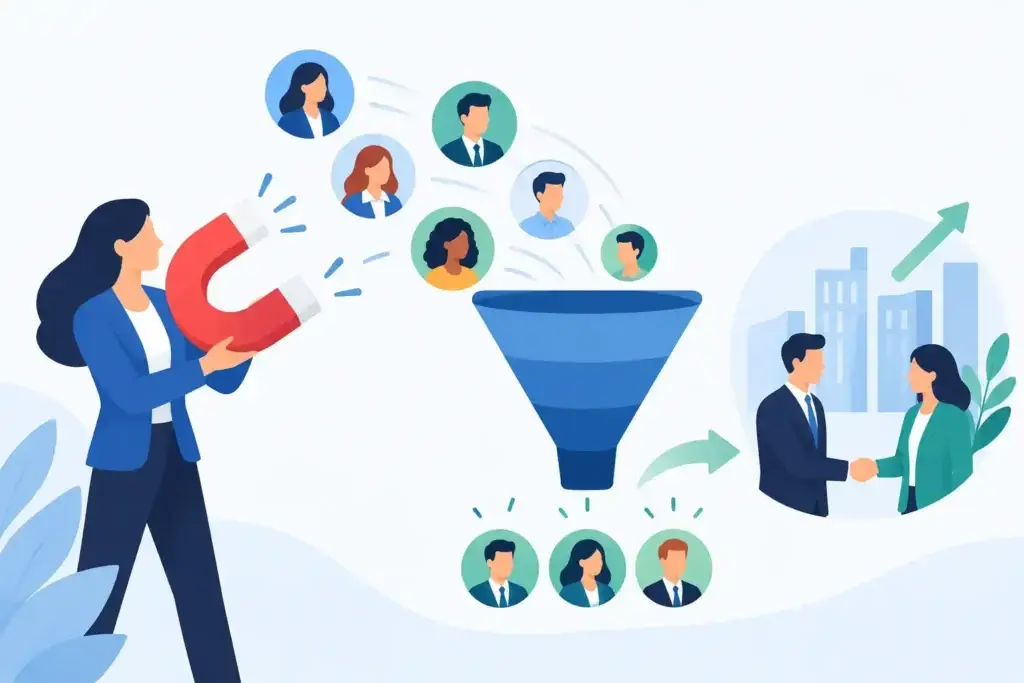
A recruiter can have a strong candidate network, experienced consultants, and a clear service model, then still lose business to a competitor that appears first when a company starts hiring. HR lead generation closes that gap. It puts your firm in front of decision-makers with an active people problem and gives them a clear reason to start a conversation.
For HR consultancies, recruitment agencies, payroll providers, and HR software businesses, more inquiries are not the real goal. The goal is a reliable flow of qualified opportunities from companies that fit your commercial model, have genuine urgency, and can become profitable long-term clients.
Why HR lead generation often produces weak inquiries
Many HR businesses market broad services to broad audiences. A website says it offers recruitment, HR advisory, payroll, compliance, training, and employer branding. The message may be accurate, but it gives a prospect no immediate reason to inquire.
Business buyers usually search or click when a specific trigger occurs. They need to replace a departing finance manager. They have opened a new location and need to hire fast. Their team has outgrown manual payroll. They received an employee relations complaint and need expert support. Lead generation performs better when it meets that moment directly.
The other common problem is treating every form submission as equal. A startup looking for one intern is not the same opportunity as a regional business planning 30 hires, even if both complete the same contact form. Your campaign, qualification process, and reporting need to separate volume from value.
Start with the buyers you can serve profitably
A clear ideal client profile makes every marketing decision easier. Instead of targeting “businesses that need HR,” define the company size, industry, decision-maker, service need, and likely contract value that make an engagement worthwhile.
A recruitment agency might focus on operations leaders at logistics and manufacturing companies hiring mid-level supervisors. An outsourced HR provider may target owner-led businesses with 20 to 100 employees that do not yet have an internal HR team. An HR tech company could focus on growing professional services firms struggling with onboarding and leave management.
This does not mean refusing every other lead. It means giving your paid campaigns, landing pages, and sales team a commercial center. When the audience is too broad, your messaging becomes generic and your cost per qualified opportunity rises.
Match the offer to a real business trigger
Your offer should reduce the perceived effort of taking the first step. “Contact us for HR solutions” is passive. A focused offer such as a hiring plan review, payroll process assessment, workforce compliance check, or recruitment market briefing is easier for a buyer to understand.
The right offer depends on your sales cycle. If your service is high value and consultative, an audit or strategy call can filter for serious prospects. If you sell a defined service with clear pricing, a direct consultation request may be enough. Avoid forcing a free offer into the funnel if your team cannot convert free advice seekers into paying clients.
Use the right channels for the demand you want
For most B2B HR services, Google Search Ads are the fastest way to reach buyers already looking for help. Searches such as “outsourced HR services,” “recruitment agency for warehouse staff,” or “payroll outsourcing company” indicate a current need. The trade-off is competition: high-intent HR keywords can be expensive, so a vague landing page will waste budget quickly.
SEO supports the same demand over a longer period. Build useful pages around specific services, industries, and business problems rather than publishing broad articles with little buying intent. A page for executive recruitment and a page for HR outsourcing serve different searches, objections, and conversion paths. They should not compete for attention on one overloaded service page.
Paid social has a different role. LinkedIn can work well when your target account list, job titles, and offer are precise, but it often costs more than search and creates demand rather than capturing it. Meta can be useful for retargeting website visitors, promoting case-based content, and staying visible during a longer decision process. It is rarely the first channel to rely on for immediate high-intent HR leads.
The practical approach is to combine channels based on timing. Use search to capture active demand, SEO to build a lower-cost pipeline over time, and retargeting to bring back prospects who were interested but not ready to talk.
Build landing pages that qualify before the sales call
Sending paid traffic to a homepage is a common and expensive mistake. A homepage needs to explain the full business. A campaign landing page needs to make one conversion happen.
Each page should lead with the prospect’s problem and the outcome your service creates. Follow that with who the service is for, how the engagement works, proof that reduces risk, and a direct next step. A recruitment landing page could explain the roles covered, expected hiring process, sector experience, and what a client receives after an initial discussion.
Keep forms short enough to complete, but ask the questions your sales team needs. Company size, hiring volume, job function, current challenge, and target timeline can reveal whether the lead is worth prioritizing. If long forms reduce conversion rates, use a short first form and collect deeper details during the follow-up call. There is no universal answer. The right balance depends on lead volume, sales capacity, and deal value.
Trust signals matter in HR because buyers are handing over sensitive business problems. Specific client outcomes, relevant sector experience, named process steps, and transparent expectations are more persuasive than generic claims about being a leading provider.
Speed to lead is part of the marketing system
A campaign does not generate revenue when a prospect submits a form. It generates revenue when the right person follows up quickly, asks useful questions, and moves the conversation forward.
Set a response standard before increasing spend. For high-intent leads, aim to respond within the same business hour where possible. Use an automated acknowledgment to confirm the request was received, but do not let automation replace a real human response. A company seeking urgent hiring support may contact three agencies. The first credible conversation often has an advantage.
Sales and marketing should also agree on what counts as qualified. A qualified lead could be a company within your target size, with a defined HR need, an appropriate budget range, and a decision-maker or clear path to one. This definition prevents arguments over lead quality and shows where the funnel actually needs improvement.
Measure revenue, not just form fills
Cost per lead is useful, but it can be misleading. A channel that produces cheap inquiries may be less valuable than one that generates fewer, larger contracts. Track the journey from click to inquiry, qualified opportunity, proposal, closed deal, and expected client value.
Review results by service line, keyword theme, audience, landing page, and industry. You may find that payroll inquiries convert quickly but produce smaller retainers, while recruitment leads cost more but create stronger revenue. That is not a problem if the economics work.
Watch for practical warning signs: rising spend with flat qualified leads, high landing page traffic with low form completion, many inquiries from companies outside your target size, or slow follow-up from the sales team. Each issue has a different fix. More traffic is not the answer to every performance problem.
Create a 90-day operating rhythm
The first month should focus on positioning, tracking, landing pages, and a tightly scoped search campaign. Start with a small number of high-intent services rather than trying to advertise everything at once.
In the second month, use actual lead data to improve targeting. Add negative keywords, adjust budgets toward stronger search themes, refine qualification questions, and improve pages where visitors are dropping off. Sales feedback is essential here. It tells you whether a lead looked good in analytics but failed in a real conversation.
By the third month, begin expanding what works. Add industry-specific pages, create supporting SEO content around recurring buyer questions, and build retargeting audiences from qualified website traffic. Growth should come from proven demand patterns, not from adding channels because they are fashionable.
HR lead generation becomes predictable when the message, channel, landing page, and follow-up process all point at the same commercial goal. Start with one service, one buyer group, and one clear problem. When that system produces qualified conversations consistently, scaling becomes a business decision instead of a marketing gamble.