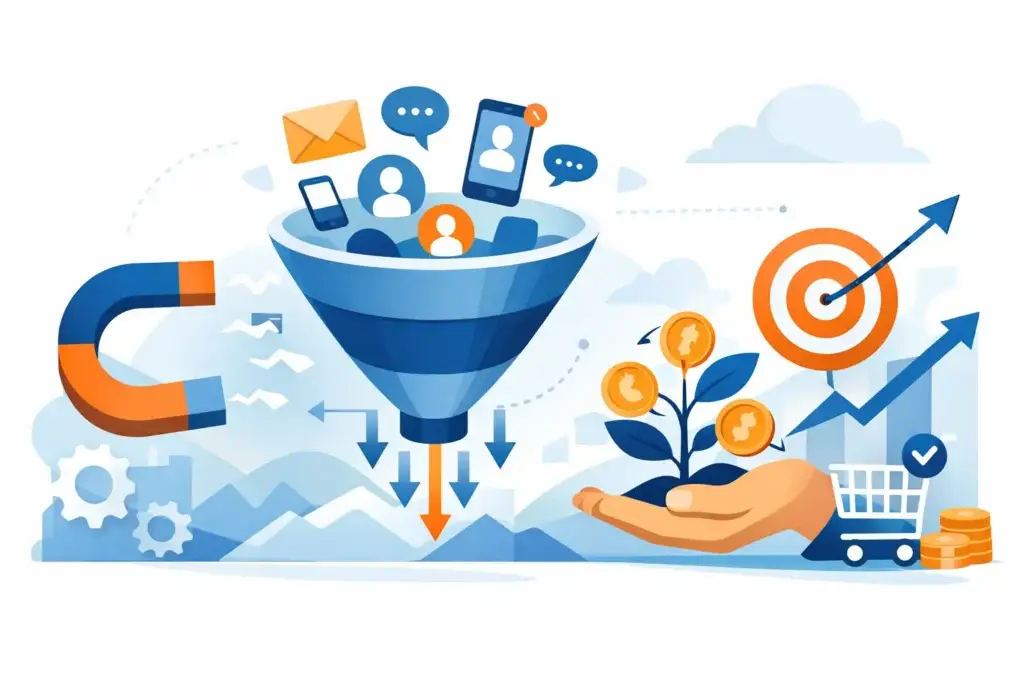
A prospect clicks your Google ad, reads two service pages, then leaves. Three days later, they see a customer result on Facebook. A week after that, they search your business name and submit an inquiry. If every channel treats this person as a stranger, you pay to win their attention repeatedly. Multi channel lead nurturing gives those separate interactions a job: move a potential buyer toward a credible sales conversation.
For SMEs, this is not about being active on every platform. It is about using the channels you already invest in to answer the next question a buyer has, reduce hesitation, and make follow-up feel relevant rather than pushy.
Why Leads Rarely Convert on the First Touch
Most service buyers do not submit a form the first time they encounter a business. They compare options, check reviews, seek internal approval, and wait until the timing is right. This is especially true for higher-value services such as renovation, HR solutions, SaaS, B2B consulting, and corporate catering.
A search ad can capture immediate demand, but it does not automatically establish trust. Social content may create familiarity, but it may not reach someone at the moment they are ready to buy. SEO can bring in highly relevant traffic, but a visitor still needs a clear reason to take the next step.
The gap between first interest and inquiry is where many campaigns lose money. Leads are collected, placed in a spreadsheet or CRM, and contacted once. Meanwhile, marketing continues to generate new traffic without helping existing prospects make a decision.
A coordinated nurturing approach fixes that operational gap. It connects paid search, website content, remarketing, email, sales follow-up, and social proof around the buyer’s stage of intent.
What Multi Channel Lead Nurturing Looks Like in Practice
Multi channel lead nurturing does not mean sending the same message through email, WhatsApp, Meta, and every available platform. Repetition without relevance creates fatigue.
Instead, each channel should support a specific part of the decision. Search captures people actively looking for a solution. Landing pages turn that intent into an inquiry by addressing the offer, proof, pricing context, and next action. Remarketing keeps your business visible while prospects compare alternatives. Email or WhatsApp can answer practical questions after a form submission. Social media and reputation management provide the evidence that your claims are credible.
Take an interior design firm as an example. A homeowner searching for “office renovation contractor Singapore” may land on a campaign page with project photos, a defined consultation process, and a request-for-quote form. If they do not inquire, remarketing can show a completed project with a realistic scope and timeline. If they do submit a form but go quiet, a follow-up message can offer a site assessment and explain what information is needed for an accurate quotation.
The message changes because the buyer’s situation changes. That is nurturing. The goal is not more touches. It is fewer unanswered questions.
Start With the Sales Journey, Not the Channel List
Before choosing platforms or automation tools, map what happens between first click and closed deal. This should be practical enough that sales and marketing can both use it.
For most SMEs, a simple journey has four stages: initial interest, consideration, inquiry, and decision. At each stage, identify the buyer’s likely concern and the proof that can move them forward.
At initial interest, buyers want to know whether you solve their problem. Search ad copy, short-form videos, and SEO content should be clear on the service, audience, and outcome. Vague positioning attracts weak clicks and makes later follow-up harder.
During consideration, buyers ask whether you are credible, affordable, and suitable for their situation. This is where case studies, reviews, portfolio work, comparison pages, process explanations, and FAQs earn their place. Do not hide every detail behind a lead form. A buyer who cannot understand your approach is unlikely to book a call.
Once a person inquires, speed matters. A response after two business days can lose to a competitor that responds in 15 minutes. Yet speed alone is not enough. The first reply should confirm the request, state the next step, and ask only for the information needed to qualify or prepare a useful consultation.
At the decision stage, the friction is often internal. Prospects may need to justify cost, explain the vendor choice to a manager, or compare proposals. Give them usable proof: a concise scope, expected timeline, relevant work examples, client outcomes, and a transparent explanation of what happens after approval.
Build One Message System Across Channels
Channel coordination starts with a shared message system. Your Google Ads, website, sales team, email templates, and social content should not make conflicting promises.
Define the core offer first. It might be a free website conversion audit, a renovation consultation, a product demo, or a paid strategy session. Then decide what proof supports that offer. For a performance marketing service, proof may include reporting visibility, client-owned ad accounts, campaign launch timelines, and the link between ad spend and qualified leads. For an F&B supplier, it may be delivery reliability, menu flexibility, and past corporate clients.
Use the same commercial facts across channels, but adapt the format. A search ad needs a direct promise. A landing page needs detail. A social post can show the work behind the result. An email can address a specific objection. Consistency helps prospects recognize your business and prevents sales teams from having to correct expectations created by marketing.
This is also where many businesses overcomplicate segmentation. You do not need 20 automated journeys to get started. Segment by source, service interest, and lead status first. Someone who requested an SEO consultation should not receive a generic eCommerce development follow-up. Someone who has already booked a call should not continue seeing introductory lead-generation ads for weeks.
Make Follow-Up Fast, Useful, and Measurable
A lead form is a handoff, not a finish line. Set a clear service-level agreement for first response. For high-intent inquiries, aim to respond during business hours within minutes, not days. If a full answer requires time, acknowledge the inquiry immediately and set an exact expectation for the next reply.
Follow-up should also match consent and channel preference. Email is useful for sending proposals, case studies, and detailed information. WhatsApp can work well for quick qualification and appointment confirmation when the prospect has agreed to be contacted there. Retargeting is useful when a person has visited key pages but has not yet identified themselves. Each method has a different role.
Track more than lead volume. A campaign that produces 100 forms is not necessarily better than one that produces 20 qualified calls. Measure the path through the funnel: landing page conversion rate, contact speed, booked consultations, show-up rate, qualified opportunities, proposal rate, and closed revenue. Where possible, pass outcome data back to the marketing team so budgets can shift toward sources that produce business, not just activity.
Common Mistakes That Waste Nurturing Budget
The first mistake is treating every lead as equally valuable. A person who downloaded a general guide needs a different approach from someone who requested pricing for a specific service. Scoring does not need to be complicated, but intent should determine urgency.
The second is relying on a single channel. Email-only nurture can fail when emails go unread. Paid remarketing-only campaigns can become expensive if the website does not provide enough proof. A combination works best when every channel is doing useful work rather than duplicating the same promotion.
The third is automating a poor experience. An automated sequence cannot repair a confusing landing page, slow sales response, or unclear offer. Fix the fundamentals before adding more software.
Finally, do not confuse frequency with momentum. If prospects see the same ad ten times without receiving a new reason to act, you are not nurturing them. You are reminding them that they already chose not to convert.
A Practical 30-Day Starting Point
Start with one priority service and one defined audience. Review the current journey from ad or organic search through to sale, then identify the two biggest leaks. For many SMEs, those leaks are a weak landing page and delayed follow-up.
In the first week, clarify the offer and update the landing page with stronger proof, a direct call to action, and form fields that support qualification. In week two, set up remarketing audiences and create a small set of ads based on customer outcomes, testimonials, or case examples. In week three, standardize sales responses for new inquiries and non-responsive leads. In week four, review which sources created real conversations and where prospects stalled.
That is enough to establish a working system. More advanced automation, CRM integrations, and audience segmentation can follow once the basics are producing clean data.
The best nurturing programs feel less like marketing pressure and more like competent help at the right moment. When your ads, website, content, and sales follow-up all make the next decision easier, prospects have a clearer reason to choose you – and your marketing spend has a better chance of turning into revenue.