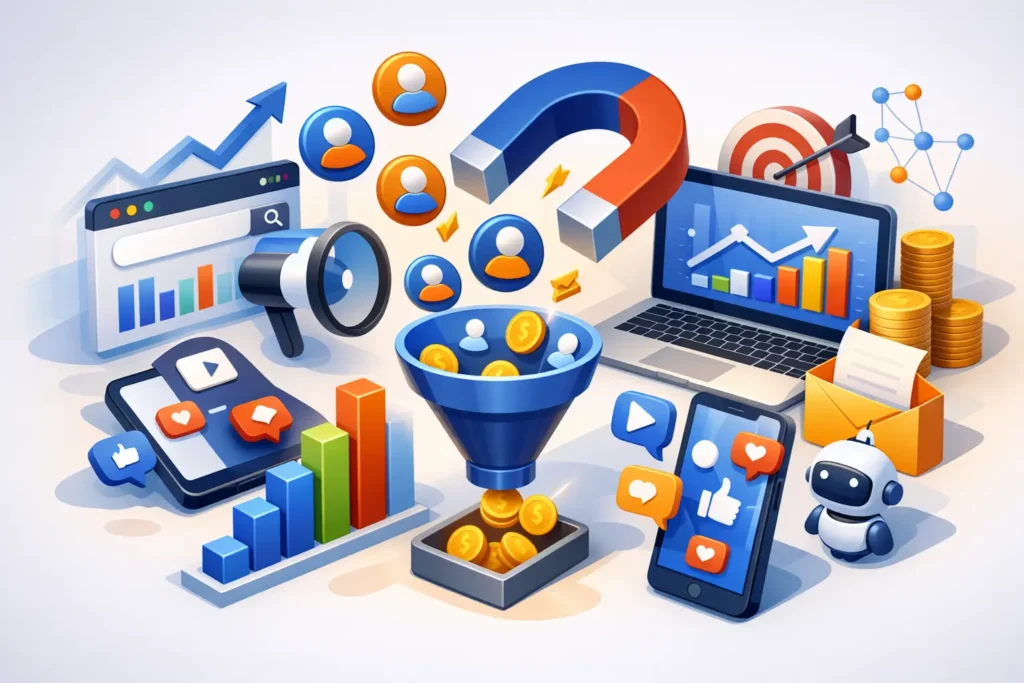
Some lead sources look busy on a dashboard and still waste your sales team’s time. That is the real problem behind the search for the best channels for qualified leads. Volume is easy to buy. Fit, intent, and conversion potential are harder, and that is where channel strategy matters.
If you run an SME, you do not need every channel. You need the right mix based on how your buyers search, how quickly you need pipeline, and what level of trust your offer requires before someone fills out a form or books a call. A local service business, a B2B consultancy, and an eCommerce brand will not get the same result from the same media spend. The strongest channel plan is usually not about chasing trendier traffic. It is about matching intent with the right message at the right stage.
What makes a lead channel actually qualified?
A qualified lead channel does more than produce inquiries. It consistently brings in people who match your target customer profile, understand enough of the offer to take the next step, and have a realistic chance of becoming revenue.
That means channel quality should be judged on more than cost per lead. A cheap lead that never answers the phone is expensive. A higher-cost lead that closes in two weeks is often a better business decision. In practice, the best measurement combines lead volume, sales acceptance rate, close rate, deal value, and speed to conversion.
This is also why channel selection should not sit in a silo. Your ad platform, landing page, lead form, sales follow-up, and CRM setup all affect qualification. A good channel can look bad if the conversion path is weak. A mediocre channel can appear better than it is if your sales team is exceptional at rescuing poor-fit leads.
The best channels for qualified leads
1. Google Search Ads for active demand
If buyers already know they need a solution and are searching for it, Google Search Ads is usually one of the best channels for qualified leads. The intent is high because the user is raising a hand. They are not casually scrolling. They are looking.
This channel tends to work especially well for local services, professional services, B2B offers with clear pain points, and any business where the customer uses direct search terms before purchasing. Think “payroll software for small business,” “commercial renovation contractor,” or “emergency AC repair.”
The trade-off is cost and competition. High-intent keywords are expensive in many industries, and poor account structure can burn budget quickly. Search also captures existing demand more than it creates new demand. If very few people search for your category, it will not scale endlessly.
Still, for fast lead generation with strong commercial intent, this is often the first channel worth testing.
2. SEO and content for compounding qualified traffic
SEO is slower than paid search, but when done properly, it can become one of the most efficient sources of qualified leads over time. It works best when your buyers research before they buy and when your website can rank for problem-aware, solution-aware, and bottom-funnel terms.
The reason SEO produces qualified leads is simple. Good search visibility attracts users with a defined need. If your content matches that need and your site makes the next step clear, the traffic is pre-filtered by intent.
But SEO is not instant. SMEs often underestimate the consistency required. Ranking gains take time, content quality matters, and technical issues can hold back performance. It is also common to rank for traffic that looks promising but does not convert because the content targets informational queries with weak buying intent.
The fix is strategic targeting. Service pages, comparison pages, pricing-related content, case-study style content, and niche problem-solution articles usually outperform broad top-of-funnel posts when qualified lead generation is the goal.
3. Referral and partner channels for trust-heavy sales
Referrals are often overlooked because they do not feel like a marketing channel in the platform sense. They should still be treated like one. In many service categories, referral leads close at a higher rate because trust is already transferred before the first conversation.
This is especially true for agencies, consultants, legal services, home services, and B2B firms selling into risk-sensitive decisions. A warm introduction removes friction that paid media cannot fully replace.
The limitation is predictability. Referrals can be high quality but inconsistent unless you build a process around them. Partner networks, client referral programs, and professional alliances help make this channel more reliable. It is not infinitely scalable, but for qualification quality, it is often near the top.
4. Meta Ads for demand creation and retargeting
Meta Ads can generate qualified leads, but the setup has to reflect how the platform is actually used. People are not on Facebook or Instagram searching for your service in the same way they search on Google. That means cold traffic on Meta usually needs sharper audience filtering, a clearer offer, and stronger creative to convert.
Where Meta performs well is in two cases. First, when the offer is easy to understand and the targeting can isolate a specific customer profile. Second, when Meta is used for retargeting site visitors or engaged audiences who already know the brand.
For many SMEs, Meta works better as part of a system than as a standalone lead source. You use search or SEO to capture intent, then Meta to stay visible and bring people back. Qualification improves because the audience is warmer.
If your sales cycle is complex or your service requires substantial trust, cold lead forms on Meta may produce volume with mixed quality. That does not mean the platform is weak. It means the campaign objective and sales process need tighter control.
5. LinkedIn for high-value B2B targeting
If you sell to specific job titles, company sizes, or industries, LinkedIn can be one of the cleanest targeting environments available. The platform is expensive relative to others, but that premium can be justified when one client is worth enough revenue.
LinkedIn tends to work best for B2B services, SaaS, recruiting, consulting, and niche enterprise offers. It is less useful for broad consumer categories or low-ticket sales.
The challenge is that clicks often cost more and conversion rates can be modest unless the message is tightly aligned to the audience. Generic offers perform poorly. Stronger performance usually comes from focused campaigns tied to one role, one pain point, and one next step.
For the right business, fewer leads from LinkedIn can still beat larger lead volume elsewhere because qualification is stronger from the start.
6. Email marketing for existing demand already in your orbit
Email rarely gets enough credit in lead generation conversations because it is not always a top-of-funnel acquisition channel. But if you already have traffic, inquiries, or a customer database, email is one of the most efficient ways to move interested prospects toward action.
That makes it a qualified lead channel in a different sense. Instead of finding strangers, it helps convert known audiences who have already signaled interest. Follow-up sequences, re-engagement campaigns, abandoned inquiry reminders, and segmented offers can all improve lead quality because they respond to prior behavior.
The main dependency is database quality. If your list is weak, unsegmented, or stale, performance drops fast. Email also requires messaging discipline. Too many businesses send broad newsletters when what they need is targeted, conversion-focused follow-up.
7. Short-form video platforms for category awareness
TikTok and similar short-form platforms can produce leads, but usually not with the same immediate qualification profile as search. These channels are better for building attention, educating the market, and generating inbound demand over time, especially when the product or service benefits from demonstration.
This can work well for visually driven categories, consumer offers, education-led services, and brands targeting younger audiences. It can also support trust if the content is direct and useful rather than overly polished.
The trade-off is intent. Many users are not in buying mode when they encounter your content. That means lead quality depends heavily on creative strategy, remarketing, and what happens after the first touch. Businesses that expect short-form video to behave like bottom-funnel search often get disappointed.
How to choose the right mix
The best channel mix depends on urgency, deal size, search demand, and buyer behavior. If you need pipeline this month, paid search usually deserves priority. If your market researches heavily before buying, SEO should not be delayed. If your average contract value is high and the buyer is specific, LinkedIn may justify the cost. If trust is the barrier, referrals and remarketing deserve more attention than raw reach.
The practical approach is to build in layers. Start with one high-intent channel and one support channel. For many SMEs, that means Google Search Ads plus conversion-focused landing pages, then SEO or Meta retargeting as the second layer. Once lead quality is stable, expansion becomes easier and less risky.
This is where integrated execution matters. A channel rarely fails on media alone. It fails because the landing page is vague, forms ask the wrong questions, tracking is incomplete, or nobody reviews lead-to-sale quality. At AdCendes, that coordination is usually where businesses recover the most wasted budget.
What to avoid when chasing qualified leads
The biggest mistake is choosing channels based on popularity instead of buyer intent. The second is optimizing for cost per lead without checking what sales thinks of the leads. The third is spreading budget across too many platforms before one channel is working.
A smaller number of well-run channels almost always beats a wide mix of half-managed ones. Focus creates cleaner data, faster learning, and better sales feedback.
Qualified leads do not come from a magic platform. They come from the right channel, with the right offer, for the right audience, supported by a website and follow-up process that does not waste the opportunity. Start there, and the next marketing decision gets much easier.
Related reading: If you want to go deeper, read real Google Ads lead generation examples and how to generate leads with Google Ads.