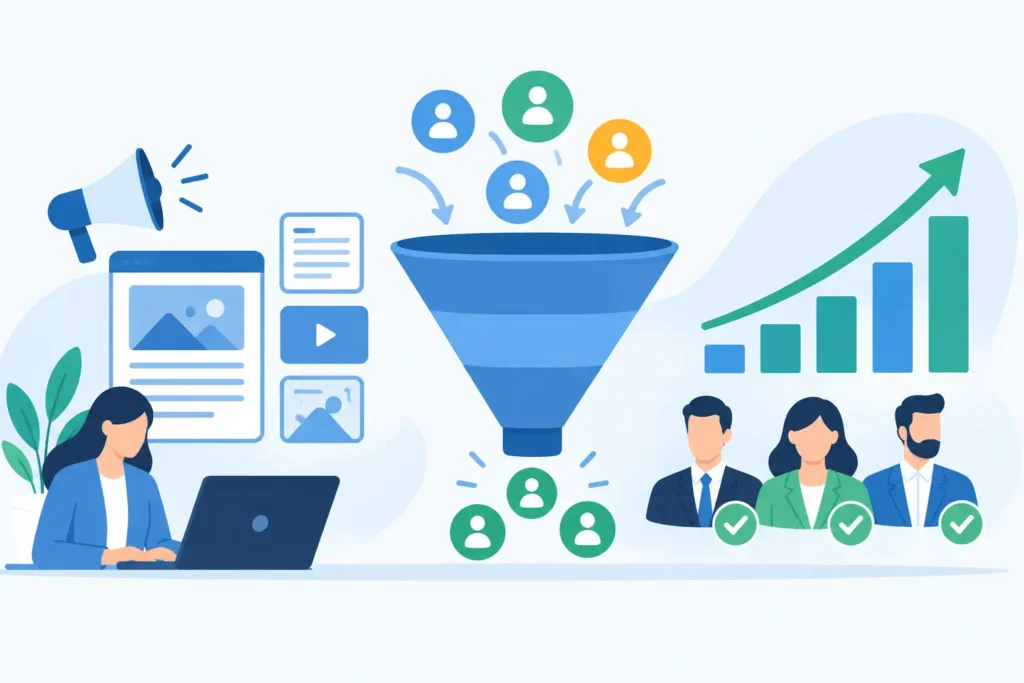
A prospect visits your website after a referral, a search, or a paid campaign. They understand the problem, but they are not ready to speak with sales yet. If your site gives them nothing useful beyond a service list and a contact form, that visit often ends there. B2B content marketing gives serious buyers a reason to stay, evaluate, and take the next step.
For SMEs, this is not a publishing exercise. It is a practical way to turn expertise into assets that answer sales questions, improve search visibility, and move prospects toward an inquiry. The goal is not more articles for their own sake. The goal is fewer unqualified conversations and more opportunities with people who understand why they need your solution.
What B2B Content Marketing Is Meant to Do
B2B content marketing is the deliberate creation of useful content for business buyers at different stages of a purchase decision. That content can include service pages, comparison pages, case studies, buying guides, industry explainers, email sequences, and short-form social posts.
The format matters less than the job it performs. A strong piece should answer a real commercial question: What does this service solve? Who is it for? What results are realistic? What will implementation involve? How does this option compare with doing nothing, hiring internally, or choosing another provider?
Business purchases usually involve more scrutiny than consumer purchases. A founder may care about speed and cost. An operations lead may care about workflow disruption. A finance stakeholder may want confidence that the investment can be measured. Content helps each person build a case before the sales call.
That is why generic thought leadership often underperforms for smaller businesses. Broad opinions can build awareness, but they rarely create urgency. A clear article that explains how to choose a payroll system, prepare for an office renovation, or evaluate lead generation costs can be far more valuable because it sits closer to a decision.
Start With Revenue Questions, Not a Content Calendar
The fastest way to waste budget is to commit to a monthly article quota before defining what the content needs to accomplish. Start with the questions your sales team, customer service team, or founders hear repeatedly.
Look for questions that signal intent. These are often about pricing, timelines, process, risks, comparisons, and suitability. A prospect searching for “how long does SEO take for a local service business” is not just looking for a definition. They may be assessing whether SEO fits their growth plan and whether an agency is being realistic with them.
Ask three questions before approving a topic. First, does the topic connect to a service or product you want to sell? Second, can your business offer a credible, specific answer? Third, is there a sensible next action for a reader who finds the content useful?
Not every topic needs an immediate sales pitch. Educational content has a role, especially when buyers are early in their research. But it should still fit a path. A guide about improving website conversion should lead naturally to a landing page audit, website project, or performance marketing discussion.
Build Around the Buying Journey
A practical content plan usually covers three levels of buyer intent.
At the awareness stage, prospects are defining a problem. They may search for causes of low-quality leads, signs their website is underperforming, or ways to improve online reputation. These articles should diagnose the issue plainly and show the cost of leaving it unresolved.
At the consideration stage, buyers compare approaches. This is where content on SEO versus Google Ads, in-house marketing versus agency support, or landing pages versus full website redesigns becomes useful. Be honest about the trade-offs. For example, paid search can generate demand faster, while SEO usually takes longer but can build lower-cost visibility over time. The right choice depends on demand, budget, sales capacity, and how quickly the business needs results.
At the decision stage, prospects need proof and process clarity. Case studies, service pages, pricing guidance, implementation timelines, and FAQs reduce uncertainty. They should explain what happens after an inquiry, what the client owns, what reporting looks like, and what results can reasonably be expected.
Make Every Piece Earn Its Place
A content program does not need dozens of weak articles. Most SMEs will get more value from a smaller library of well-targeted pages that answer high-intent questions thoroughly.
Start with your core commercial pages. If you sell a service, the page should not simply announce that the service exists. It should explain the business problem, the scope of work, the expected timeline, how success is tracked, and who the service is best suited for. This is content marketing too. In many cases, improving these pages produces a stronger commercial outcome than publishing another top-of-funnel blog post.
Then create supporting articles that feed those pages. A Google Ads service page, for example, can be supported by content on campaign setup mistakes, realistic lead-generation timelines, keyword intent, landing page conversion issues, and how to assess ad performance without relying on vanity metrics.
The content should be specific enough to be useful and restrained enough to protect your time. You do not need to reveal every internal process. You do need to demonstrate that you understand the operational realities behind the buyer’s problem.
For a service business, that may mean explaining why lead volume alone is not a success metric. Ten inquiries mean little if they are outside your service area, below your minimum project value, or impossible to contact. Better content speaks to lead quality, qualification criteria, response time, and conversion tracking.
Write for Decision-Makers, Not Search Engines
Search visibility matters, but content written solely to repeat keywords usually feels thin and unconvincing. Decision-makers can tell when an article avoids the difficult parts.
Use plain language and make claims you can support. Replace vague statements such as “we drive growth” with details about the mechanism: improving conversion paths, targeting high-intent searches, creating clearer service pages, or connecting campaign data to qualified inquiries.
Good B2B content also acknowledges limits. SEO is not the answer when a business needs leads next week. Paid ads will not fix a weak offer or a website that gives visitors no reason to act. Social content can strengthen credibility, but it may not be the most direct acquisition channel for every sector.
This level of candor builds trust because it helps buyers make a better decision, even when the answer is not the most convenient one. It also filters out prospects who expect impossible results or are not ready to invest in the work required.
Distribution Is Part of the Work
Publishing is not distribution. Once a strong article or case study is live, use it where prospects already encounter your business: sales follow-ups, proposals, email nurture sequences, social posts, paid campaign landing paths, and conversations with referral partners.
A useful guide can give sales teams a credible follow-up after a discovery call. A case study can support a proposal without forcing the prospect to accept broad claims at face value. A comparison page can help a prospect explain the recommended approach internally.
This is also where channel coordination matters. Search ads can send immediate traffic to a focused landing page while SEO content builds longer-term visibility around related questions. Social media can reinforce expertise and bring past visitors back into the conversation. The channels should support the same commercial story rather than operate as separate activities with separate messages.
Measure Business Movement, Not Content Activity
Page views are useful context, but they are not proof that content is working. Track whether the right visitors are reaching commercial pages, submitting qualified inquiries, booking calls, downloading relevant resources, or returning before they convert.
For longer sales cycles, measure assisted conversions as well. A prospect may first find an educational article, return later through branded search, and finally submit an inquiry after reviewing a case study. Giving all credit to the final visit can cause businesses to cut content that played a meaningful role earlier in the decision.
Keep reporting straightforward. Review the topics that bring qualified traffic, the pages that support conversions, and the gaps prospects still raise on calls. Then update the content plan based on evidence. If a page attracts visits but produces no relevant action, the problem may be the topic, the search intent, the call to action, or the offer itself.
A useful B2B content program should make selling easier, not create another marketing task to manage. Start with the questions that delay deals, answer them with real operational clarity, and give every useful page a next step. That is how content becomes an asset your business can keep using long after it is published.